
Here are my predictions:
* Dave Cooke and Brooke White in the finals
* Bottom three for this week are going to be Ramiele, Chikezie, and some other person.
* The 17-year old kid goes home sometime soon unless he starts singing songs that aren't really, really lame
From the NYTimes:
Mrs. Clinton proposed creating a “high-level emergency working group” to devise ways to restructure mortgages at risk of default. And whom might she put on this elite squad? Two people whose track records on mortgages have come in for criticism lately: Alan Greenspan and Robert E. Rubin.Considering that Hillary is supposed to be the policy wizard candidate, this is a bit surprising. It seems as if her experience isn't so much a fact base that she is using to make better informed decisions, but rather a Rolodex of people that she can call to tell her what to do.
...
Mrs. Clinton was asked about her choice of Mr. Greenspan during an interview with the editorial board of The Philadelphia Daily News. According to Will Bunch, a senior writer for the newspaper and the author of the Attytood blog, this was her response, with emphasis added by Mr. Bunch:Not only that, but the Fed didn’t act while he was there. But he has a calming influence still to this day on Wall Street — don’t ask me why because I never understand what he’s saying — but nevertheless people respond to that Delphic oracle approach. I think it would be wise to include him. And recently he’s come out, and very smartly so, that we have to deal with housing and maybe we need to have some kind of buyout mechanism for mortgages. So he’s moved on his understanding and depth of the problem — but you know you could pick three others. You just have to have some demonstrable involvement of presidential leadership.

* Recipes have both the English and the Chinese names (in pinyin and characters). Now I can finally figure out how to cook a ton of dishes that I only have a Chinese name for
* The recipes look pretty authentic - no carrots or tomatoes, but a lot of Sichuan peppercorns, chili oil, bean paste, etc.
* It tells you where you can actually buy some of the otherwise hard-to-find ingredients (I'll save you the effort, go to Adriana's Caravan)
* Almost all of the recipes look incredibly delicious
This book is great for people with my pretty narrowly defined profile, i.e. Chinese American with relatively broad exposure to Chinese food, but without enough cooking experience to just improv everything. Anyway, with any luck, I'll be feasting on some tight home-made suan ni bai rou and sichuan liang mian by the end of the week.
What I would like to see from more conservatives
0 comments Published by Panda on Sunday, March 23, 2008 at 5:08 PMJohn Cole writes:
If only an actual conservative in power would say this.Balloon Juice: I see that Andrew Sullivan was asked to list what he got wrong about Iraq for the five year anniversary of the invasion, and since I was as big a war booster as anyone, I thought I would list what I got wrong:
Everything.
And I don't say that to provide people with an easy way to beat up on me, but I do sort of have to face facts. I was wrong about everything.
I was wrong about the Doctrine of Pre-emptive warfare.
I was wrong about Iraq possessing WMD.
I was wrong about Scott Ritter and the inspections.
I was wrong about the UN involvement in weapons inspections.
I was wrong about the containment sanctions.
I was wrong about the broader impact of the war on the Middle East.
I was wrong about this making us more safe.
I was wrong about the number of troops needed to stabilize Iraq.
I was wrong when I stated this administration had a clear plan for the aftermath.
I was wrong about securing the ammunition dumps.
I was wrong about the ease of bringing democracy to the Middle East.
I was wrong about dissolving the Iraqi army.
I was wrong about the looting being unimportant.
I was wrong that Bush/Cheney were competent.
I was wrong that we would be greeted as liberators.
I was wrong to make fun of the anti-war protestors.
I was wrong not to trust the dirty smelly hippies.I mean, I could go down the list and continue on, but you get the point. I was wrong about EVERY. GOD. DAMNED. THING. It is amazing I could tie my shoes in 2001-2004. If you took all the wrongness I generated, put it together and compacted it and processed it, there would be enough concentrated stupid to fuel three hundred years of Weekly Standard journals. I am not sure how I snapped out of it, but I think Abu Ghraib and the negative impact of the insurgency did sober me up a bit.
War should always be an absolute last resort, not just another option. I will never make the same mistakes again.
Link via Brad DeLong

Is this true in New York, or am I just a really nice tipper? Well, according to Epicurious, it's pretty much a local thing:UNITED STATES
In a restaurant, a tip of 15 percent for good service is still the norm, while many give 20 percent for superior service. And don't tip the wine steward, unless he has performed exceptional services, like choosing several wines for a multi-course meal or decanting old vintages.
Back when I was waiting tables, it was taken as a given that certain types of customers tipped better than others. New Yorkers, for example, always sent back plates, needed more bread, called for seconds and thirds on their iced teas, etc., but left at least 18 to 20 percent, if not more. Southerners, on the other hand, didn't run you and generally liked to chat, but regularly gave you 12 percent or less. Midwesterners were less thrifty than Southerners but also often less friendly. Men tipped better than women. Getting a guy on a first date was a godsend. Getting a table full of high-school kids (who invariably only ordered french fries and bottomless coffees and made a mess of the sugar packets and ketchup) was valid reason to start a ruckus with the host. And don't get me started on Europeans. I found that servers generally held the same ideas about who tipped best and worst whether they were slinging hash in North Carolina or running bowls of bouillabaisse in Greenwich Village.
Putting the sale of BSC in perspective
4 comments Published by Panda on Monday, March 17, 2008 at 11:34 AMJPM's cost for acquiring BSC:
$236-$270MNNY Yankees' cost for acquiring A-rod:
$275MN, with an additional $30MN if he breaks the home run recordYeah. BSC < A-Rod.
**************************
Update:
I mixed up the BNs and MNs signs, which are now fixed. That being said, this is still crazy.
One of the most tragic outcomes of the Spitzer scandal is the tarnishing of his legacy as New York's attorney general. It's sad that the current state of politics is such that a man's private failings are considered sufficient reason to ignore their public victories. To get a sense of what I mean, here's a quote from Portfolio.com's Odd Numbers blog.
Such a shame.Out of 20 S.E.C. settlements for market timing by mutual funds, 16 involved Spitzer when he was New York's attorney general.
The percentage of illegally-gotten money that mutual funds had to give back in the Spitzer cases was 80 percent -- almost full restitution.
In the 4 settlements not involving Spitzer, the S.E.C. settled for 7 percent.
Why the gap?
Part of it was Spitzer's aggressiveness, but the other factor was that younger S.E.C. officials usually go work at the firms they're in charge of regulating. So, the incentive to bring the hammer is, ummm, somewhat compromised.
Breaking my original oath, but...
0 comments Published by Panda on Wednesday, March 12, 2008 at 4:58 PMThis will only make sense if you watched the Democratic debate in Ohio, where Hillary was really big on making Barack "reject" an endorsement from Farrakhan, even though Obama had just said that he emphatically denounces Farrakhan's anti-Semitic comments. That being said, this from the NYTimes:
For the last two days, Ms. Ferraro has been sharply criticized for comments she made last week that suggested Mr. Obama had succeeded as far as he had because he was black.Tsk, tsk. Does this mean denounce > reject?
“If Obama was a white man, he would not be in this position,” she told the Daily Breeze, a newspaper in Torrance, Calif.
...
Mrs. Clinton said yesterday that she “rejected” Ms. Ferraro’s original comments. But questions persisted about why she had not denounced them more sharply and whether they actually worked to the Clinton camp’s advantage with white voters.
Facebook slowdown - Anecdotal perspective
3 comments Published by Panda on Tuesday, March 11, 2008 at 12:07 PMSAI has a college person reporting on why facebook growth is slowing. It's just another person's opinion and doesn't add anything new, but it sounds right and pretty much squares with my experience.
Facebook's new mass-market appeal has eliminated its niche appeal. Facebook simultaneously has begun to lose its novelty for some of the first-generation users and to drive them away with the same features that are meant to attract them.If the platform were a little bit more flexible, I think I'd probably use facebook for everything that I do with this blog. It has a huge built-in advantage, in that it's built to constantly update my friends on what I'm doing.
Personally, I use Facebook a lot less than I did as a freshman. I haven't added any of the new applications, and for the most part, neither have my friends. SAI reported that the average Facebook user comes back to the site less often and stays around for shorter periods of time, and that correlates exactly with my experience.
If I get an e-mail notification that someone has added a photo of me or written on my wall, I'll go on for a minute to check it out, and then log off. I used to go on Facebook to procrastinate, and now I usually go on for a specific, short-term purpose. I wouldn't go so far as to delete my account, though (although I'm glad it's finally possible to do so); being a member is still a necessity in college.
Unfortunately, there are just some issues that I can't get around. The biggest is access control. There are totally random people connected to me on facebook, and I just don't want all of them to have access to everything that I write. Roger Ehrenberg wrote something way back when about wanting the ability to have three different profiles, one for friends, family, and colleagues that I think is more or less what I want. Although, I'd probably shift colleagues to acquaintances and just be as MECE as possible. In any case, it would be interesting to see the data and figure out what's actually going on up at facebook.
Link

Jayant Agarwalla, 21, told The New York Times in an article published over the weekend that they did not create Scrabulous to make money, even though they now collect about $25,000 a month from online advertising. They just wanted to play Scrabble on their computers, and their favorite (unauthorized) site had started charging, he said.Still, they are now taking in $300,000 a year and, according to Silcion Alley’s back-of-the-envelope calculations, with a 10- to 20-times-revenue multiple that would make Scrabulous worth $3 million to $6 million. Allowing for a what the blog calls “a hockey-stick growth curve,” it could be worth more than $10 million, Silicon Alley said.
But according to the publication, again citing an anonymous source, “the brothers want a ‘multiple of several times that’ $10 million, and the four corporations they’re negotiating with think that’s ridiculous.”
I think it's kind of awesome that these guys can take someone else's idea, post it on-line, and then demand tens of millions of dollars from the company that actually owns the game. I mean, if you wrote a book, and then I stole, published and distributed a copy of it, would it make any sense for you to pay me a huge multiple of what I might potentially make off of the book that you wrote? If only I could be so lucky!
I can see that the game companies are trying to avoid consumer backlash and are probably conscious of the negative publicity that the RIAA and the MPAA have received for suing MP3 downloaders. But Hasbro and Mattel are dealing with guys that blatantly ripped them off and are now making $300k a year off of their game, not with the actual consumers of the product.
I think it's also funny that even though the game companies have been treating the Agarwalla brothers with the utmost of care, that there's still a consumer backlash, with facebook groups planning to boycott sales of Scrabble. People are addicted to getting things for free, and they get pissed when someone indicates that they shouldn't have ever had it in the first place. In light of this, I'd be curious to see what the response would be like if Hasbro/Mattel put out an official Scrabble application that was similarly free and of good quality, and then had the courts shut down Scrabulous for violation of their IP. Would people be mad because of the use of the legal system, or would they be fine because they could still play Scrabble online for free?
A news snippet from the NYT:
Relatively barren stretches of the Atlantic and Pacific Oceans around the tropics have expanded about 15 percent since 1998, according to a new satellite study. The study’s authors said that the change could be temporary given the short period of observations but that it matches a slight but steady warming trend in the affected ocean regions and matches a pattern scientists have predicted would occur under global warming. The study’s authors, from the National Oceanic and Atmospheric Administration and the University of Hawaii, said warm surface waters tended to block upwellings of deeper, nutrient-filled water necessary to support plankton and other marine life. The Indian Ocean has seen similar changes but with a less measurable trend, they said.That's particularly worrisome. Aside from being the base of the marine food chain, plankton produces somewhere between 50-90% of the global oxygen supply, according to NASA estimates. It's a wide-ranging estimate, but the number is large on either end of the spectrum.
Steve Jobs recently upset a lot of people by saying that nobody reads books anymore, and hence the development of eReaders is irrelevant. Here's his quote, taken from the NYT:
It doesn’t matter how good or bad the product is, the fact is that people don’t read anymore,” he said. “Forty percent of the people in the U.S. read one book or less last year. The whole conception is flawed at the top because people don’t read anymore.A lot of people have attacked that statement. But it looks like eReaders may have other issues to deal with. From ArsTechnica:
Survey data shows books have the highest "attachment" rating of any leisure media activity. People are more attached to their books than they are to their satellite television, radio stations, newspapers, magazines, social networks, video games, blogs, DVDs, and P2P file-swapping. And it's not like this high rate of affection for the book occurs only among a small group; books came in second only to "listen to the radio" in terms of the number of people who engage in those activities.Here's the silver lining:
... When the survey asked about people's emotional attachment to paper books, 53 percent of respondents said that they would "never" or would "hate" to stop using them, and another 24 percent said they would be "uncomfortable."When asked directly about the appeal of e-book readers, 39 percent of the respondents said that the readers were appealing or very appealing, but 61 percent had the opposite reaction.
The survey notes that familiarity with the devices seems to boost their attractiveness to most people, and 17 percent of respondents did say they would almost certainly purchase a reader once they learned about all of its features and benefits.Even so, that's not a very high number. I have to wonder if that statistic would get a boost if Apple announced that it was making a super stylish eReading device oriented at hipsters and their teenaged emulators.
From the NYTimes:
Virtually all studies since then confirm that monosodium glutamate in normal concentrations has no effect on the overwhelming majority of peopleWikipedia seems to partially confirm this.
- The 1987 Joint Expert Committee on Food Additives of the United Nations Food and Agriculture Organization and the World Health Organization placed monosodium glutamate in the safest category of food ingredients.
- A 1991 report by the European Community's (EC) Scientific Committee for Foods reaffirmed monosodium glutamate's safety and classified its "acceptable daily intake" as "not specified", the most favourable designation for a food ingredient. In addition, the EC Committee said, "Infants, including prematures, have been shown to metabolize glutamate as efficiently as adults and therefore do not display any special susceptibility to elevated oral intakes of glutamate."
- A 1992 report from the Council on Scientific Affairs of the American Medical Association stated that glutamate in any form has not been shown to be a "significant health hazard".
- A 1995 FDA-commissioned report acknowledged that "An unknown percentage of the population may react to monosodium glutamate and develop monosodium glutamate symptom complex, a condition characterized by one or more of the following symptoms:
- Burning sensation in the back of the neck, forearms and chest
- Numbness in the back of the neck, radiating to the arms and back
- Tingling, warmth and weakness in the face, temples, upper back, neck and arms
- Facial pressure or tightness
- Chest pain
- Headache
- Nausea
- Rapid heartbeat
- Bronchospasm (difficulty breathing)
- Drowsiness
- Weakness
- Sweating." This list of mostly very non-specific and common symptoms was compiled from anecdotal reports[5]
- A 2002 report from researchers at Hirosaki University in Japan found rats fed on diets very high in glutamate (up to 20%) suffered eye damage. Lead researcher Hiroshi Ohguro said the findings might explain why, in eastern Asia, there is a high rate of normal-tension glaucoma.[6]
Hillary Clinton in her victory speech:
"Ohio knows how to pick a President!"
Which is exactly why we've had eight years of George Bush.
At this point, it sounds like the MSM is going to say that Hillary Clinton has staged an amazing comeback and we're now looking at a real contest again.
To that, I would say that the MSM really needs to stop covering this election. Nothing that's happened today contradicts any of the poll data that's been publicized on a daily basis for the last few weeks. It's just silly for anyone to say that today is a huge upset, or a huge swing in momentum, when the fact is that today's outcome has essentially been forecast for quite some time.
At this point, I'm just tired of all the attention being paid to the primaries. If they drag this out to July, as Hillary indicated that she would, then I may seriously start skipping over all related articles from now on.
Cute quote from CNN: "Hillary Clinton's won sort of a pyrrhic victory. Obama is the hope and inspiration of the Democratic party, and even for some Republicans. Going negative on him is sort of like killing Santa in front of the kids."
More on last.fm - Measuring musical diversity
2 comments Published by Panda on Monday, March 03, 2008 at 1:33 PMI've been looking into some of the third-party uses of last.fm data. Some of the stuff is pretty cool. For instance, there are two online tools measuring diversity of taste. By both metrics, I'm not super-boring, but I'm not pushing any envelopes either. Here's a quick synopsis:
Range of musical artists:
I thought this was pretty cool. The actual test comes in two flavors, the standard eclectic and the super eclectic. This test looks at the first 5 (or 20) artists associated with artists in your Top 20 (or Top 50). The diversity of your tastes is then calculated as a percentage of the possible maximum (100 or 1000). I came up with a score of 468/1000. You can see how that stacks up to everyone else on last.fm in the following chart.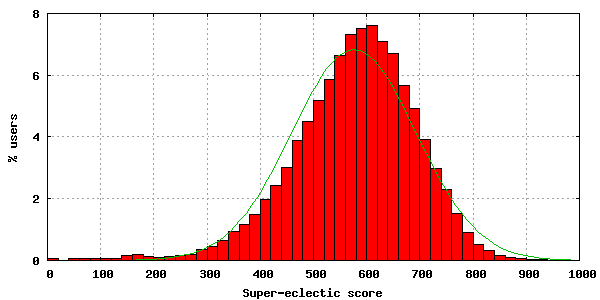
AEP (Anti-Exponential Points):
This metric essentially looks at the number of plays your most favored artist gets vs. the number of plays of your 50th most favored artist. The underlying math looks a little stupid to me, but it does look at something that the previous metric avoids, namely the degree of concentration in the top tier. Anyway, I submitted myself to the test and got a 3.69/5, which again means I'm not super diverse, but I don't suck either. Unfortunately, these guys didn't put together a neat little histogram of their distributions.
There is, however, a group of high-scoring and low-scoring people. Both of them (and particularly the high-scoring set) seem to do nothing but listen to Radiohead all the time.

I stopped using last.fm for a while, because the service was still pretty clunky and the Scrobbler (where do they get these words?) would crash my computer pretty routinely. Besides, last.fm couldn't keep track of anything that I listened to off of the computer, which at that point was about 60% of my musical consumption. So, I let iTunes keep track of all my musical doings.
Today, I imported all of my iTunes history back into last.fm and am now using it to manage everything. I had to ditch my old last.fm profile, but in return, I get to see about 25x more data. Looking at the evidence, I'm struck by a few things about myself.
1. My listening habits are highly concentrated in a core set of artists. I wish I could pop the data into Excel so I could draw up the concentration chart.
2. I'm a lot less musically adventurous than I thought I was. Back in the day, I would have said that I'm pretty balanced across genres. The data doesn't lie - I'm a dyed-in-the-wool mainstream rock fan with indie leanings. Hip hop and electro are just blips on the radar of my listening habits.
3. I'm a lot less passionate about the music that I'm listening to today. My profile is almost entirely based on what I listened to about a year ago. Since then, I've barely listened to anything in my Top 20 artists/albums. Of the albums that I'm listening to now, they barely register in my overall charts.
If I ever have a kid, I'm going to have him scrobble pretty much everything he/she listens to. I think it would be so cool to have the entire history of your musical consumption ready for review. In case anyone's interested in seeing my tastes, ranging from roughly January 2006 to the present, take a look here.
Robert Shiller in the NYTimes on information cascades:
ONE great puzzle about the recent housing bubble is why even most experts didn’t recognize the bubble as it was forming.First, this article reminds me of all those guys that tried to prove that there wasn't a housing crisis in '07 by pointing at market reactions. At least Ben Stein used external data points to hypothesize that nothing was happening.
...
Three economists, Sushil Bikhchandani, David Hirshleifer and Ivo Welch, in a classic 1992 article, defined what they call “information cascades” that can lead people into serious error. They found that these cascades can affect even perfectly rational people and cause bubblelike phenomena. Why? Ultimately, people sometimes need to rely on the judgment of others, and therein lies the problem. The theory provides a framework for understanding the real estate turbulence we are now observing.
...
The fundamental problem is that the information obtained by any individual — even one as well-placed as the chairman of the Federal Reserve — is bound to be incomplete. If people could somehow hold a national town meeting and share their independent information, they would have the opportunity to see the full weight of the evidence. Any individual errors would be averaged out, and the participants would collectively reach the correct decision.
Of course, such a national town meeting is impossible. Each person makes decisions individually, sequentially, and reveals his decisions through actions — in this case, by entering the housing market and bidding up home prices.
Suppose houses are really of low investment value, but the first person to make a decision reaches the wrong conclusion (which happens, as we have assumed, 40 percent of the time). The first person, A, pays a high price for a home, thus signaling to others that houses are a good investment.
The second person, B, has no problem if his own data seem to confirm the information provided by A’s willingness to pay a high price. But B faces a quandary if his own information seems to contradict A’s judgment. In that case, B would conclude that he has no worthwhile information, and so he must make an arbitrary decision — say, by flipping a coin to decide whether to buy a house.
The result is that even if houses are of low investment value, we may now have two people who make purchasing decisions that reveal their conclusion that houses are a good investment.
As others make purchases at rising prices, more and more people will conclude that these buyers’ information about the market outweighs their own.
Less snidely, I think this crystallizes/explains an argument that I've had against the efficiency of markets for a long time. Think about markets as a Wikipedia for pricing information. Looking past a lot of the obvious parallels (e.g. crowd sourcing, larger players having a marked impact on the outcome, etc.), there is one key difference. In writing a Wikipedia article, you could never cite Wikipedia as the source. As hypothesized above, this doesn't seem to be the case with the market.
The media in the living room
0 comments Published by Panda on Thursday, February 28, 2008 at 9:25 AMMicrosoft and Sony have been trying for years to bring the experience of the PC to the living room, spending millions of dollars in state of the art consoles that were supposed to merge all of your media into a single station. To this day, that hasn't happened. Stubbornly, the Internet has stayed glued to the desktop.
Except in one spot - the mobile phone. Why is it that the phone, which at first seemed somewhat ill-suited to Internet browsing, has managed to become the next hub of development? It's because the phone changed its form to accommodate some of the new demands that were being placed on it. They made their screens bigger, added full-fledged keyboards and data connections. Hell, the iPhone even introduced a touch screen to simulate the mouse-click.
What have Microsoft and Sony done? They added Internet connections to their video game consoles and then developed proprietary systems that allow people to connect to each other solely in the context of the universe that they've tried to create. At least the Wii has an Opera browser. If any of these guys really want to harness the power of the Internet in the living room, here's what I would suggest:
1. Allow the millions of portable keyboards (i.e. Blackberries, iPhones, etc.) in the world to be used in conjunction with the system. If you don't have a keyboard, it's pretty darn hard to get around the web.
2. Open up the platform and let other developers create an ecosystem that takes advantage of the technology.
Until this happens, those consoles are just consoles. Not Trojan horses that can be used to take over the rest of the Internet. Because at this point, that seriously isn't going to happen.
I got bored last night and set up a new tumblelog, iamverytall.tumblr.com. For those of you that don't know what a tumblog is, the line that they give is:
"If blogs are journals, tumblelogs are scrapbooks."After actually looking at how tumblelogs (that's a really long name, now that I have to keep typing it) work, I have to admit that I don't really get it. The chief differentiator between a tlog (ah, much shorter) and a blog is that it's a lot easier to add media posts to tlogs than it is to blogs, e.g. you don't have to find an alternate site to host that mp3 that you want to put up, you can e-mail photos from your phone, etc. But that's additional functionality, and it doesn't preclude me from using tumblr in the exact same way that I use Blogger. Maybe I'm missing something, but it's hard to see why a blog is any more text-friendly than the tlog, save for the most superficial of reasons. Bottom line, there's no obvious reason that the tblog can't be both a journal and a scrapbook, and if I'm going to manage an online presence, I'd rather do it where I have more options, not less.
Of course, I could be missing something. So I'll play along with it for now, and will probably use it to post music, pictures, etc.

I would be really surprised if facebook's growth was over, but I think it's only to be expected that the rate of growth is starting to slow. Part of it has got to be that long-time users are coming in less frequently. Most of my friends that have been on since '04 barely log in anymore - the fascination with endlessly surfing through your friends' photos eventually loses its hold. Wall posting is great, but it can eventually lose its luster.
Pudge still checks up on facebook with great frequency. When one of her coworkers broke up a gaggle of facebook talk by saying, "Facebook is lame," Pudge responded by saying, "Andrew is old."
My guess is that facebook will have to macro-drivers that will push it forward for years to come. The first is international expansion. While I was in Istanbul, I was amazed to find that the majority of people at the client site were totally engrossed by facebook (one of them friended me within 30 minutes of our first meeting). They'd all heard about it before and were extraordinarily anxious to use it. I'm guessing that this will be largely the case in numerous countries, save for a couple with already well-entrenched players. This seems to be borne out by facebook's global numbers:
Link.

That’s according to researchers at the University of Wisconsin who are studying people’s attitudes towards nanotechnology, an emerging scientific field that involves manipulating molecules and atoms. They found that just 29.5% of the 1,000-plus Americans surveyed said they thought nanotechnology research was morally acceptable.Do these people even know what they're condemning?
Hopefully, the US will loosen up its H1-B policies so we can actually get a couple people with real educations into the country.

Perhaps in response to criticisms that have been building in recent days, Mr. Obama pivoted Tuesday from his usual incantations. He dropped the pretense of being a candidate of inspiring but undescribed "post-partisan" change. Until now, Mr. Obama has been making appeals to the center, saying, for example, that we are not red or blue states, but the United States. But in his Houston speech, he used the opportunity of 45 (long) minutes on national TV to advocate a distinctly non-centrist, even proudly left-wing, agenda. By doing so, he opened himself to new and damaging contrasts and lines of criticism.Is this what's coming down the pike?
Mr. McCain can now question Mr. Obama's promise to change Washington by working across party lines. Mr. Obama hasn't worked across party lines since coming to town. Was he a member of the "Gang of 14" that tried to find common ground between the parties on judicial nominations? Was Mr. Obama part of the bipartisan leadership that tackled other thorny issues like energy, immigration or terrorist surveillance legislation? No. Mr. Obama has been one of the most dependably partisan votes in the Senate.
...Unlike Bill Clinton in 1992, Mr. Obama is completely unwilling to confront the left wing of the Democratic Party, no matter how outrageous its demands, no matter how out of touch it might be with the American people. And Tuesday night, in a key moment in this race, he dropped the pretense that his was a centrist agenda. His agenda is the agenda of the Democratic left.
In recent days, courtesy of Massachusetts Gov. Deval Patrick, Mr. Obama has invoked the Declaration of Independence, Martin Luther King, Jr., and Franklin Roosevelt to show the power of words. But there is a critical difference between Mr. Obama's rhetoric and that of Jefferson, King and FDR. In each instance, their words were used to advance large, specific purposes -- establishing a new nation based on inalienable rights; achieving equal rights and a color-blind society; giving people confidence to endure a Great Depression. For Mr. Obama, words are merely a means to hide a left-leaning agenda behind the cloak of centrist rhetoric. That garment has now been torn. As voters see what his agenda is, his opponents can now far more effectively question his authenticity, credibility, record and fitness to be leader of the free world.
Iron Chef America - Exposed?
0 comments Published by Panda on Thursday, February 21, 2008 at 12:27 PM
Several things slowly dawned on us as we watched the taping. The participants went about their tasks methodically but unhurriedly, as if they had all the time in the world. There was none of the huddling and dialogue among team members that we expected, even though they had to develop a menu from scratch using an unknown ingredient. Like a lightbulb coming on over our heads, we realized that the chefs had known the identity of the main ingredient all along, just as they had known ahead of time which Iron Chef would be paired with the challenger. How else to explain the utter nonchalance displayed by the sous chefs, who fetched ingredients and blended them; toasted, fried, and roasted them; then plated them like they were enjoying a relaxing holiday in the country.Seriously, did anyone actually think that they were all just whipping out four-five courses without knowing anything before taping? For the most part, Sietsama seems to get really upset that a lot of stuff in the Iron Chef TV show aren't actually true in real life. I'm pretty surprised that anyone thought that they would be. That being said, he does mention a couple of things that are kind of interesting. They are:
* The competing Iron Chef is chosen before the show is taped - the other chefs are actually just look-alike stand-ins
* The chefs actually aren't all that rushed while they're making their dishes
* The judging section of the show takes 3 hours to tape
Link originally via Eater
Ok, this should be my last post for today, promise. I've been talking to Pudge about whether or not we think a recession is here/on the horizon. From what I've read, it's here and it's going to be long, big and nasty. Read that as: If you've got a job, try your best not to get fired.
From what she's read, it might be here, but even if it is, it probably won't last that long. Her view is that while the American consumer will probably be hard hit, a significant portion of the American economy has achieved enough global exposure to absorb the adverse effects. At least, I think that's what she said; if I'm wrong, she can always add a comment and correct me.
Anyway, just to add some fuel to the fire, here are a few select comments from the esteemed Marty Feldstein, whom some of you Harvard types might remember as being one of the inspirations for Mr. Burns (italics are mine):
Here's a quick bullet point summary of the rest of the article:Although it is too soon to tell whether the United States has entered a recession, there is mounting evidence that a recession has in fact begun. Key measures of economic activity stopped growing in December and January or actually began to decline. The collapse of house prices and the crisis in the credit markets continue to depress the real economy...
If a recession does occur, it could last longer and be more painful than the past several downturns because of differences in its origin and character. The recessions that began in 1991 and 2001 lasted only eight months from the start of the downturn until the beginning of the recovery. Even the deeper recession of 1981 lasted only 16 months.But these past recessions were caused by deliberate Federal Reserve policy aimed at reversing a rise in inflation. In those cases, the Fed increased real interest rates until it saw the economic slowdown that it thought would move us back toward price stability. It then reversed course, reducing interest rates and bringing the recession to an end.
In contrast, the real interest rate in 2006 and 2007 stayed at a relatively low level of less than 3%. A key cause of the present slowdown and potential recession was not a tightening of monetary policy but the bursting of the house-price bubble after six years of exceptionally rapid house-price increases. The Fed therefore will not be able to end the recession as it did previous ones by turning off a tight monetary policy.

* Fall in national housing prices is unprecedented, depressing wealth and consumer spending
* Biggest problem is the paralysis of/lack of confidence in the credit markets
* No one has any idea how much their credit instruments are now worth, which is preventing anyone from buying anything
* Unfortunately, the only way we know how to establish market value for these instruments is by seeing how much other participants are paying for them
* No one has any idea how to fix any of this
For those of you that have any interest in this kind of thing, I'd recommend reading Feldstein's article. Similar to the subprime primer that I linked to the other day, it also provides a crystal clear view of the situation at hand, albeit with fewer stick figures.
Link via the Big Picture

If you're willing to look, there's a substantial amount of substance behind that Obama style. For starters, explore the Obama campaign Web site, and you'll find the standard array of campaign-issue papers on the economy, health care, Iraq and foreign policy. And now, the Obama campaign managers are responding to Sen. Clinton's criticism by highlighting and, well, beefing up those position papers.Now, the interesting point:
Here's the rub: As anyone who has listened to Sen. Obama knows, the substance of policy positions takes a decided back seat to the more ephemeral ideas of hope and inspiration when he addresses voters. The basic Obama argument is that America can solve its problems, that the country can transcend partisan divides, that Washington can overcome gridlock and that he, as a new leader unbound by the debates of the past 20 years, is the one who can make all those things happen.I've tended to ignore most people's arguments that Obama is light on substance, given the complementary set-up and the "Obama is pretty much the same as Hillary on the positions" argument. But I do think the commentator is right - people are not necessarily voting for Obama's positions as much as they're voting for his brand of politics. If that's the case, I'd be curious to see what will happen once he gets into office and what will come of his efforts to actually get people behind his ideas.
The beauty of this Obama approach, aside from its presenter's impressive oratorical skills, is that it is so in tune with the mood of many Americans, who seem to want both to be inspired and to leap beyond partisanship.
The risk, though, is that rhetoric that is light on substance might fail to unite voters in either party or the country behind specific, often difficult, steps a new president would have to take. Campaigns are for winning -- and for building a consensus on what is to be done after the victory.
In this case, is Sen. Obama building a case for renegotiating the North American Free Trade Agreement, or for ending it? Is withdrawing troops from Iraq within 16 months a goal or a deadline? They are significant questions, and Sen. Obama's task is to be sure his campaign is shedding light on the answers.
I'm not an economist, but I do like reading blogs from economists. One of the things that I've picked up on from some posts has been the idea that China is not a source of inflation, when you look at the data. Here's a clip from the WSJ:
“Imports constitute around 15% of U.S. GDP and around 13% of that comes from China,” the authors write in an article in the latest issue of China & World Economy, an English-language journal published by the Chinese Academy for Social Sciences. On their back-of-the-envelope calculation, that means a 1 percentage point increase in China’s inflation rate should lead to an increase in U.S. inflation of 0.02 to 0.03 percentage points. Yet their comparison of historical price trends in China with those in both the U.S. and Japan found the actual effect was even smaller.And here's one from Paul Krugman:
In fact, overall, the US spends a little more than 2 percent of GDP on Chinese goods. That’s dramatically more than in the past. But it suggests that if Chinese prices rise 10%, the overall cost of living here would rise by less than a quarter of a percent. Every little bit hurts, but this isn’t as big a deal as a casual reading of this article might lead you to think.Fine, so if the prices of Chinese imports go up, the total effect in the US won't be that big. But, what about the effect of China on the price of commodity inputs? Here's a graph of real oil prices in Feb. 2008 dollars.
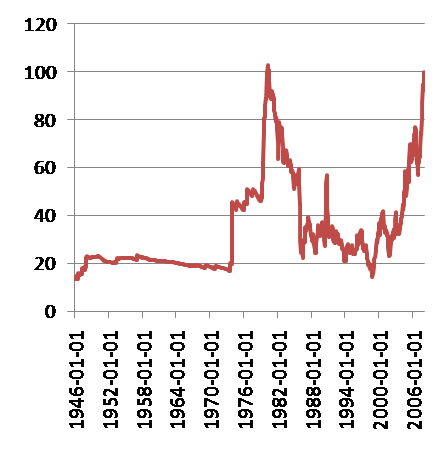 Now, what I've been reading is that the run-up in oil prices can be partially attributed to Fed Monetary policy. But the other thing that could be driving it is huge demand growth coming from China, and to a lesser extent India. I have no way of telling which of these two factors is playing a larger role. However, let's say that factor #2 is in fact big. Wouldn't that subsequently mean that China is playing a significant role in global inflation? Someone enlighten me.
A couple days ago, I had a thought about food trends. The thought was that food staples have essentially been commoditized, due to the manufacturing processes used to achieve scale. This has opened the door for higher end, branded food products that trump up their home-grown processes. Hence Berkshire pork, slow-churn ice cream, Niman Ranch bacon, artisanal cheeses, fresh hand-made pasta made from durum, and all that jazz. My thought was that something like that would soon happen to butter, as there is clearly room for differentiation in both the process (e.g. freshness of the ingredients, churning style) and the perceived quality of the output.
Lo and behold:
ANNE SAXELBY had what she calls an “aha moment” a couple of years ago when she drove upstate to try the cultured butter made by Evans Farmhouse Creamery in Chenango County. Ms. Saxelby, who owns Saxelby Cheesemongers in Manhattan, said that for all the butter she had eaten in her life, “I had really never had butter before — this is butter.”
More and more people across the country are being treated to the same aha experience as they find a burgeoning variety of fresh dairy products made in small batches on little farms and in small creameries. And it’s worth the extra money.
Of course, anecdotes in the Times do not a trend make. But still, it's always fun when something that you were thinking about shows up in print within a couple of days.
Speaking of anecdotes, from the same article:
Nancy Nipples started the Pike Place Market Creamery in Seattle 30 years ago, selling milk, butter, cream and the like to help local independent dairies... (Nancy Nipples is the name she uses to sign checks; her full name, taken after a divorce, is Nancy Nipples the Milkmaid.)Her name is what?!
Link courtesy of Pudge
From Ars Technica:
Effective immediately, Toshiba will ramp down shipments of HD DVD players with an eye towards stopping them altogether by the end of March. The company left open the possibility of continuing to ship laptops with HD DVD drives installed, but it's difficult to believe that there would be any demand for them
Glad I'm no longer one of those early adopter types.
As many of you might have guessed from the recent flurry, I'm a touch bored these days. There hasn't been a lot of project flow and I'm still waiting to hear back from some people on things that I've sent out. In any case, here's an interesting factoid that I just found.
I've been going through consumer bankruptcy filings recently and have been astounded by the levels of credit card debt that show up on some (but certainly not most) debtor's schedules of assets and liabilities. I've seen a bunch of cases with upwards of $60,000 of debt for a single debtor, a few with over $100,000, and the current record holder is $175,862.27. Yes, that's right, $175,862.27. That's larger than a lot of mortgages.Yowch.
This debt was incurred on 25 cards from 12 different lenders, all major national financial institutions. No less than 9 of the cards and $80744.16 of the debt were for one lender, Bank of America. The debtor's annual post-tax income is listed at around $85,000, and the debtor has been in her current job and industry for a while.
Link.
This is about as clear of a picture of the subprime mortgage mess that you'll ever get. Stick figures included:
[Link via The Big Picture]

This post was inspired by a recent post at RW/W about Moody, a 3rd-party app for iTunes that allows you to do "mood-tagging." Basically, it just organizes your songs into playlists for you, which I think is pretty useless. But I think the problem it's trying to solve is one that would make my life a lot easier. Over the years, I've amassed a pretty sizable collection of music. Organizing it in a clean, understandable fashion has definitely been one of my biggest frustrations.
There may be some of you out there that don't bother to organize your music and wonder why I would even care to do so. The primary answer is for browsability. I have so much music that I frequently forget what I do/don't have, and find myself often rediscovering albums. The holy grail of organization would make this process a lot easier.
I use iTunes as my primary music player. The search function is great. I like that it keeps track of what I've listened to both on the computer and on my iPod/iPhone. I've rated a ton of songs and I think that makes it a lot easier for me to refind songs that I like. And I think that the browser is a lot easier to manage then a bunch of folders on a hard disk, as it simultaneously cuts across the three axes of music-browsing - artist, album, and genre. You could toss year released in there, but I think that's a bit tougher to use.
For browsing purposes though, genre really seems to be the only way to go, for a couple reasons. First and foremost, given a sufficiently large selection, there will be too many artists and albums. Secondly, except for a few rare outliers, there won't be enough musical variety within one artist/album, meaning that you have to keep switching around if you want to put together a playlist of any variety. Thirdly, artists/albums are pretty concretely defined categories, meaning that the contents of these categories aren't really that subject to change.
The problem with using genres for browsing is that it's a huge pain to label things. You can only apply one genre to each song! That's pretty useless in my book. A lot of good music cuts across genres. Even bad music cuts across genres, to be honest (e.g. Diddy-influenced fusion of R&B and hip hop).
Solution: Apple, allow people to tag songs in iTunes.
Before anyone goes rushing off to tell me about awesome online apps that do this, let me answer by saying that I'm really not interested in using web interfaces for this kind of thing. When you're managing this much volume, the extra portion of a second per operation will translatesinto a cumulatively huge difference.

From the NYTimes:
Reaction #1.Mr. Obama’s campaign said that he had a lead of 1,139 to 1,003; by the count of the Clinton campaign organization, Mr. Obama was doing even better: 1,141 to 1,004 for Mrs. Clinton.
There are 1,082 delegates left to be selected.
With every delegate precious, Mrs. Clinton’s advisers also made it clear that they were prepared to take a number of potentially incendiary steps to build up Mrs. Clinton’s count. Top among these, her aides said, is pressing for Democrats to seat the disputed delegations from Florida and Michigan, who held their primaries in January in defiance of Democratic Party rules.Reaction #2.
The delegate math set up a new front in the battle for the party’s presidential nomination, one based on competing views of how the party leaders and elected officials whose vote will determine the outcome should make their decisions.
Mrs. Clinton’s aides said the delegates should make their decision based on who they thought would be the stronger candidate and president. Mr. Obama argues that they should follow the will of the Democratic Party as expressed in the primary and caucuses — meaning the candidate with the most delegates from the voting.
Branding is one area of business that remains a mystery to me. All the things that you do with your brand, that makes sense to me. But the initial design, particularly of the logo, is something I've always found to be outside of my core competencies. Some people have that kind of creativity, others (me) don't.
The following are snippets from an article from Google Operating System, originally from Wired, about how Google designed their now world-famous logo. "In the process, Ruth used a lot of symbols: from a pattern that suggests the infinite to interlocking rings that symbolize the power of search to transgress cultures, from a happy magnifying glass to sheer playfulness. "By taking out the magnifying glass, Kedar opens up the logo to signify that Google can become much more than just a search engine. By playing with the angles and colors of the letters, she tries to make clear that Google isn't a square corporation."
Ruth Kedar explains that she chose the Catull typeface because "Catull borrows elements from traditional writing instruments such as the quill and the chisel with a modern twist. Search, by nature, is an activity that requires we look into the past. Therefore Catull's historical ties seemed appropriate, as did the bridging between the old analog world and the new emerging digital era."
As a follow-up to the Wikinvest post, I grabbed the following adoption curve from Barry Ritholtz at the big picture. It's an illustrative curve depicting technological adoption. I'm assuming that the x-axis is time and the y-axis is the rate of adoption, although Ritholtz never made that comment explicitly.
Here is a grossly over-simplified discussion of how this works: When the innovators buy a product, they essentially are paying for all of the R&D costs, and other development expenses. You paid 365 labor units for a VCR in 1972 because they were a limited production, custom product that was practically hand made. When a PC cost 465 labor units, chip fabs were nowhere near as plentiful as today -- and the biggest cost in early PCs were the exorbitant chipsets contained in them.One thing that Ritholtz doesn't mention is the chain of causality linking the pricing effects he's describing and the actual rate of adoption. My guess is that there's a feedback effect between the two, with higher adoption rates spurring incremental upgrades to manufacturing capacity and the resulting reduction in prices drives further adoption by those that might have previously been priced out of the market.
The early adopters pay less than the innovators, as factories get built to mass produce chips or tape transport mechanisms or cell phone keypads. What was a nearly custom made product becomes a merely limited-production, high-end one. Where the innovators paid for the R&D, the early adopters paid for the fabs and factories to be built.
The early majority doesn't get the use of the product for the first few years, but they get a big price benefit of manufacturing economies of scale. Mass production of components bring prices down; successful products attract competition to the space, and soon more manufacturers are cranking out more units. Through competition, prices begin dropping faster and faster. The late majority gets even cheaper prices. Consider the laggards and the VCR today -- they cost about $29 each.
Of course, this is a highly simplified view of how the market works. Adding one layer of complexity, what happens if price isn't an issue, as it is in most internet properties? I'm thinking the curve would look largely the same, but with much sharper swings, as adoption would largely be driven by network effects, rather than any dependency on manufacturing capability. That is, without the iterative feedback loop smoothing adoption rates, you'd see much more sensitivity to single events, e.g. a bump on TechCrunch.
There's a possibility that there could be an adoption curve based on the site's evolution. Essentially, rather than pegging adoption rates to the product's monetary cost, you could peg it to the frictional cost of using the site. For instance, I stopped using Wesabe mainly because it wouldn't actually pick up some of my account information, making it much more of a hassle to use their site. Assuming that over time, they identify and fix these issues, it's possible that I'll come back. Again, just idle speculation. Anyways, back to work.
Every so often, I add widgets to the side of the page. It's very easy now that Blogger's been revamped. However, every time I add a new widget, the widget will default to include the following html snippet.
In theory, I think that snippet should allow me to make "quick edits" to the blog, as long as I'm logged in. In practice, that snippet just adds a load of white space to the widget and forces everything that follows it to the bottom of the page. This means I have to cut that snippet out every time I add a new widget, which can be a pain in the butt. If anyone's got an idea of how to fix this, let me know.

Just some quick commentary on the site, from my perspective.
Things they're getting right:
I think they're doing a pretty good job along a couple of fronts. First, I think the reputation system is pretty good (i.e. better than I've seen at other Wiki's), and could function as a modest incentive to get people to add what they know. Will it stop people from trying to game the system? I'm less confident about that. But still, given that the name of the game is to build critical mass, providing some incentives is far better than providing none.
Second, I think their seed content is a good step in the right direction. To be honest, if the content wasn't as good as it is, I think the site would be DOA. Again, it's a good step, but it still feels incomplete. I think they need to keep building on the seed until they have enough of an audience that it will start building itself.
Third, I haven't seen it yet, but the data tables that they're going to roll out sound like they'll be good. It's an open question as to whether they'll actually work, but if they do, that would be a strong development.
Things to work on:
The chief aim, for now and forever, is to build an audience. Moreover, that needs to be a recurring audience, as opposed to a spiky, one-time audience (e.g. the kind of audience Elfyourself had). Ideally, that audience should be engaged enough that they'll start contributing and take the content-development burden off of the site's editors.
I think the last point should be the key focus. Right now, I think there's enough reasonable content that they might be able to attract users for a bit. But without a focal point of engagement, they won't come back, nor will they contribute. Their current initiative - adding data tables - will make the site more useful to casual visitors, but it strikes me as being yet another piece that they'll have to seed and update until they build critical mass.
Here are some thoughts:
* They should do everything they can to turn their list of contributors into a community. I'd imagine that they should at least have a news feed and forums/discussion boards, rather than their current freeform discussion pages
* They should emulate Wikipedia and funnel visitor contributions towards certain key pages, so as to facilitate more visible development
* They should build on their current reputation system and begin rewarding high-performing contributors in some way
* Structuring an entire post is likely to be too big for a casual visitor. Somehow streamlining this process, or maybe creating a standard template, would make this process go a lot more smoothly
Since Google's acquisition of feedburner, it's gotten a lot easier to get high quality tracking stats for these pages. Interestingly enough, traffic to this page has gone up pretty significantly with the primary season, with the largest influx coming in on Super Tuesday.
Mind you, these aren't people that are actually interested in what I have to say. As anyone that's been following this page knows, my posting frequency has taken a swan dive off the edge of a cliff over the last few months, and is only now starting to resurface. The bulk of all my traffic is coming from searches.
What is it that people are searching for? Apparently, this article. The searches leading to it are for:
| Traffic Source | Visits | Trend |
|---|---|---|
| Search for "obama smoking" | 17 | — |
| Search for "obama smokes" | 2 | — |
| Search for "barack obama smoking cigarettes" | 2 | — |
I did a quick check on Google to see just how easy it would be to actually find my site using any of those sources. Basically, the only way is to find me on the 3rd page of the image search, which yields a thumbnail not of Obama smoking, but of the Panda avatar in the upper right corner. So, considering that the clickthrough rate for that particular link must be incredibly low, that's got to mean that there are a ton of people searching for pictures of Obama lighting up.
Yet another indicator of our cultural health.
Lawrence Lessig's take on all of this
0 comments Published by Panda on Tuesday, February 12, 2008 at 12:20 PMThis video is taken from Stanford Law's Lawrence Lessig. Guy's got a sharp knack for flash, I'll say that.
I'm sure that most of you know what my opinion on this video would be. However, as a counterpoint, here are some responses that he got on his own blog.
Comment #1, from Seth Finkelstein
Reasonably argued, but regrets, I don't buy it.
1) Obama's no angel
From factcheck.org: Harry & Louise Again? February 4, 2008
Obama mailer on Clinton health care plan lacks context.
Summary: An Obama mailer stretches the differences between the candidates on health care"
2): Running for President requires an ENORMOUS amount of money. It has to come from somewhere. And Obama gets plenty of fat-cat support (can't give links or the spam-trap will eat this message).
3) US foreign policy in the Middle East is majorly driven by the economics of oil and alliances thereof. What the "Arab street" is going to see is not "change" but a colonial administrator, of a type they know real well. You're putting way more importance on symbols meaningful to US liberal intellectuals than make any real difference on the ground.Other stuff:
4) Obama is a rookie. Going up against an experienced, mean, veteran in many senses. I don't see he can handle it. Bleating "Change!" isn't going to cut it.
5) Moral courage is easy when there's no cost to it. I view him as mostly having taken a gamble that paid off on opposing the Iraq War, rather than it being an issue of right vs. popular. Anyone who keeps doing right and not popular in politics loses power (to a first approximation).Comment #2, by joe
Did I miss something? How is a man who is focusing on corruption, implying that Hillary Clinton is not for campaign finance reform and hailing Obama as a beacon of hope? Hillary Clinton is a supporter of public financing (e.g. Canada), whereas Obama is apparently a supporter of people giving money but not lobbyists. Don't ask me how Obama's thing makes sense, or how Mr. Lessig can rail against people for being misleading while being misleading himself!?: Including that blurb about Hillary saying she won't join Edwards and Obama in their election campaign gimmick but leaving out the public financing part. Also, I have never heard anyone argue that Obama has as deep an understanding of the issues as Hillary. It seems intelligence and experience would be the first defense against special interests' misleading attacks. Sorry for the caustic letter, but Mr. Lessig's endorsement is hypocritical and does not make sense based even on his own priorities. It also ignores deep differences in the candidates stances towards health care and other issues. Let's face it, Mr. Lessig is endorsing Barack, like many Europeans, because he is black and charismatic. Not bad reasons, but not good enough. Almost as bad as my reasons for making improper use of a colon above.
Comment #3, from Marc Perkel
Serious factual problems with your video
First - Obama wasn't in the Senate at the time the vote to allow Bush to abuse his powers and start a war. Since that vote Obama has vored the same as Hillary on every issus regarding Iraq. He has not made a single principled vote since he took office.
Second - it was Obama, not Clinton who introduced racism into the South Carolina and quite frankly I'm not going to support Obama unless he apologizes for distorting what clinton said painting Clinton as a racist. You are absolutely dead wrong on this issue. Obama has run a far dirtier campaign that Hillary.
Third - when it comes to "moral strength", look at the 1993 attempt Hillary made on health care reform. Hillary took a principled stand and failed to accomplish anything. One thing about experience is the ability to actually get things done, not just take a principled stand and accomplish nothing. Obama is all talk.
Even though neither of us agree with everything the Clintons did in the 1990s, the have the strongest record of accomplishment of any president in my lifetime. The bottom line is that if Hillary is president you're your going to see more of what accomplished. If we elect Obama we're going to see someone who talks about the problems in a more inspirational manner.
I respect you Larry, but you are totally dead wong on this one.
Here's something I sent out to my Church of Reality mailing list. I didn't make an endorsement, but tried to lay out the issues as cleanly as I can.
And, on a stupider note, comment #4, from Common Sense
Two interesting counterpoints today. The first comes from a Paul Krugman Op-Ed article, a certified Hillary supporter:
"I won’t try for fake evenhandedness here: most of the venom I see is coming from supporters of Mr. Obama, who want their hero or nobody. I’m not the first to point out that the Obama campaign seems dangerously close to becoming a cult of personality. We’ve already had that from the Bush administration — remember Operation Flight Suit? We really don’t want to go there again."He then goes on to cite examples of Obama supporting "venom:"
"During the current campaign, Mrs. Clinton’s entirely reasonable remark that it took L.B.J.’s political courage and skills to bring Martin Luther King Jr.’s dream to fruition was cast as some kind of outrageous denigration of Dr. King.In response, many of his readers responded, ostensibly citing examples of anti-Obama rhetoric coming from the Clinton camp. This is Krugman's response in his blog:And the latest prominent example came when David Shuster of MSNBC, after pointing out that Chelsea Clinton was working for her mother’s campaign — as adult children of presidential aspirants often do — asked, “doesn’t it seem like Chelsea’s sort of being pimped out in some weird sort of way?” Mr. Shuster has been suspended, but as the Clinton campaign rightly points out, his remark was part of a broader pattern at the network."
"[Krugman quoting Clive Crook]Generally, I'm a fan of Krugman's and find his analyses to be dead on target. But I think in this case, he's making several key mistakes.It really makes me sad to see so many people get played by the media on this. If you prefer Obama, fine — but the evil, race-card-playing Clinton campaign is no more real than Al Gore’s claim that he invented the Internet.Some commentators accused Bill of playing the race card when he called Obama’s account of his position on the Iraq war a “fairy tale”. How so? What did that have to do with race? And does Hillary’s comment about King, the only instance Morris bothers to offer, even qualify? She merely said that getting the job done required a can-do president as well as an inspiring and visionary champion. And so it did. I cannot see that this subtracts anything from King’s stature, or that it was intended to. Whatever its merits, this is the Clintons’ old theme, not a sinister new one: if elected, she would hit the ground running, whereas the inexperienced Obama would be out of his depth. It took a hyper-sensitive press to turn that comment into a racial slur.
….
I think the press played the race card, not the Clintons.
And to Obama supporters, just remember: these people are not your friends. After they take down Hillary Clinton, if they can, your man will be next...
Folks, you’ve been played like a fiddle by people in the media who just plain hate the Clintons. They tried to take Hillary down over her clothes, her voice, her tears. When none of that worked, they invented a race war."
The first is that his argument about rabid, venom-spewing Obama supporters just doesn't seem to wash with me. The instances that Krugman cites as being evidence of rabid anti-Clinton rhetoric from Obama fans are also being perpetrated by the media. In fact, the second instance that he cited is purely about the actions of MSNBC and has nothing to do with any of Obama's supporters. If he thinks that the Clinton's should not be held accountable for the media's spinning of their commentary, then he should extend the same courtesy to Obama and his supporters.
Secondly, I'm in agreement that a lot of the anti-Clinton rhetoric is the result of media hypin, but it is simply not the case that Hillary's Rovean style tactics are purely the creation of the media outlets. There are clear cases in which Senator Clinton has willfully distorted facts in order to cast doubt upon Barack's record. For instance, she and her husband tried to dismiss his record on the Iraq war by saying that he took his speech off of his website and that he continuously voted to fund the war. The first statement is simply false, the second one completely misleading (as you can be against a war, but still vote to give your troops money for armor and supplies, given that they are already at war and will need these things to survive).
In another instance, she took comments made by Obama about how Reagan's transformational status and the GOP's status as the "party of ideas," and then distorted that in a debate, reframing his comments as support for those ideas.
Thirdly, I think Krugman needs to step back a bit. It's fine if he supports Hillary and thinks that she has a better plan for universal healthcare. That's a valid point and one that I will take into account when thinking about who to support. But I think that he's doing a disservice to his camp and to the party by casting Obama supporters as saps for a cult of personality, or marionettes dancing to the press's puppeteering. How can anyone reasonably insult supporters of a differing candidate (which is more highly educated, according to the polls) and then expect them to just turn around and switch? If anything, his rhetoric is merely going to carve out divisions all the more clearly between the two sides.
As some of you may have surmised from my recent Google away tags, I'm an Obama fan. Here's some of my reasoning, as I originally laid it out in a comment on Fred Wilson's blog. It starts with the single most effective argument in the Clinton campaign, namely her years of experience.
I think the experience argument doesn't take you very far. First, Hillary Clinton's experience, as measured by actual number of years in political office, does not significantly exceed Obama's. What she can lay claim to is being around for most of her husband's experience. However, she has admitted that they never shared confidential information, limiting the extent to which those years can really be called "experience."
Secondly, if experience is such a big deal, then the Democrats should have mobilized behind Joe Biden or Bill Richardson. But they didn't. And if we get into a presidential race with John McCain, having a campaign built on "experience" really isn't going to get anyone very far, as his 25 years in Congress dwarfs Hillary's 7.
The biggest point that I'd like to make is that number of years of experience just does not seem to be a strong predictor of presidential quality. Note that Abraham Lincoln had only a single term in the House of Representatives prior to becoming President. Some of our greatest presidents in recent history had similarly short amounts of political experience, including both of the Roosevelts and Woodrow Wilson. On the other side, some of the presidents with the most experience have turned out to be complete failures, e.g. Richard Nixon, Gerald Ford.
What I find interesting is that years ago, a president made an argument that “The same old experience is not relevant," and that time spent with real people was just as valuable as time spent in Washington, if not more so. That was Bill Clinton, campaigning against George Bush. Now he and his wife are finding that same language being used against them and they are trying to deny its importance.
I think the biggest issue is what you do with your experiences. You can have all the experience in the world, but if you don't learn the right lessons, then that experience is wasted. I agree with Hillary on most policy issues. I think that universal healthcare will require mandates if they're to be effective. I think we should try and do the right thing in Iraq, rather than beating a hasty exit (although Obama's withdrawal argument is based solely around using it as a hammer to bring about self-governance). If she made it into office, I'd probably be fine because she'd be pushing my agenda.
However, everything that I've read about her management style indicates that she is not the type of person to brook dissenting opinion (See Brad Delong's experience working with Hillary, or David Brooks's recent article in the Times). These anecdotes are admittedly old and she might have changed since then. But I think the teeth that came out in South Carolina are a worrisome indicator that she still has the same "My way or the highway" perspective, and the last eight years have shown us that we can't afford to have that as a country. Her candidacy will almost certainly be a 51% victory, even with the help of some of the strongest Democratic tailwinds in recent decades.
The right policy decisions can go poorly, if arrived at in the wrong way. There were plenty of reasons why we could have gone into Iraq, but we did it in the worst way possible. I think Obama's natural tendency to build a consensus is the right way to set the ship right. We need a political process that is open and honest, not one where decisions are made behind closed doors, where leaders can't admit to their mistakes, and where ideas from one party automatically become anathema to the other. We need someone who can carry us past the 51% majority mark. I know this probably sounds preachy to some of you, but I like to think that it's just being earnest, a character trait that a lot of politicians should be more willing to exhibit.
This factoid comes to you via Marc Andreesen's blog, which came to him via the FT:
EMI, the big music company, spends 25 million pounds a year "to scrap unsold CDs".
I'm sure that those 2,000 people that they just laid off are psyched about that.
Why it's probably better that I have a girlfriend
0 comments Published by Panda on Monday, January 07, 2008 at 9:05 PMIt is currently five past midnight. Pudge left this morning for the CES conference in Vegas, although she apparently took a pit stop at the AVN's for good measure. For today, the sum of my productive accomplishments include the following:
* Stopping by the office for good measure and postage
* Mailing something
* Buying groceries for myself
Those groceries included the following: Vitamin water, beer, gummy bears, chicken nuggets, hot sauce, beer, an apple, and some bananas. This is what I am planning to live off of until Pudge comes back, which I believe to be on Wednesday.
The apartment looks like it has been savaged by an angry bear. There are at least three distinct piles forming in the living room; two of them clothing-based, one of them the remains of my grocery shopping. Other articles from the day - a book and sections of newspaper - are lying exposed on a table, next to a random pad of paper that I pulled out and doodled on. My shoes are not on the shoe rack in the closet. The bed has not been made.
I have been playing Guitar Hero III in nothing but my socks and boxers for over two hours. My eyes burn, as I have not looked at a non-electronic surface for more than 10 consecutive seconds in the last ten hours. My back is sore, possibly from the strange dances that I have begun to perform in accompaniment to the music that I have been 'playing.' My face and hands are coated with a fine layer of oil, which I seem to have been secreting for the day. There must also be oil in my hair, which now has spikes vaguely resembling the nimbus on the Statue of Liberty. I can't be sure, but I'm guessing that I smell. I am a glorious mess.
This will all come to an end soon, when Pudge comes back and order re-enters my life. But until then, my life is chaotic bliss.
Ok, back from Turkey, Taiwan, San Francisco, and Mexico. It's been a long trip. I'm sure all of you missed me dearly. Thanks to Pudge, here's some material from the Economist. In short, it argues that beauty (or it's scientific proxy, symmetry) can be a marker for "other, underlying characteristics such as health, good genes, and intelligence." Here's the bigger quote:
'... three researchers correlated people's bodily symmetry with their performance on intelligence tests. Such tests come in many varieties, of course, and have a controversial background. But most workers in the field agree that there is a quality, normally referred to as “general intelligence”, or “g”, that such tests can measure objectively along with specific abilities in such areas as spatial awareness and language. Dr Miller and his colleagues found that the more a test was designed to measure g, the more the results were correlated with bodily symmetry—particularly in the bottom half of the beauty-ugliness spectrum.'
I have two responses to this (if it's true, of which I'm somewhat skeptical). First, if this is true, then it must really, really suck to be ugly. The second one would be to wonder why this didn't seem to make much of an impact at my school/workplace.


Are you serious? Are you off your damn rocker?? You're favoring a MUSLIM, whose religion has an allegiance to Africa, (and that is NOT optional)!! Not to mention the fact that when the American Flag was raised and all were raising their hands to their hearts and singing praise to our beautiful country, Obama turned his back on OUR FLAG, and refused to put his hand over his heart, nor pledge his allegiance to the Flag of our country. ...You know, that country he's running for PRESIDENT of.
WHAT IS WRONG WITH YOU IDIOTS?! Open your eyes you morons!! He wants to pull our troops out, and you think that is a good idea?! Our founding fathers are rolling over in their graves for all they did to give us this nation, only to have an uprising of an evil generation come in and ruin it.
Bush did the RIGHT thing sending troops into these countries. He caught a man who has been murdering his own, and putting fear into Americans for DECADES, and sent a clear message that we as Americans will not sit with our eyes closed and allow MUSLIMS to kills thousands of our people senslessly because A: they're jealous of our freedoms, and B: because they're so sick they think that murdering people will take them to heaven and they'll have 40 virgins waiting for them. What!?!? Won't they be surprised after they drove those planes into our buildings, leaving thousands of families without mothers, husbands, FATHERS, MOTHERS, sons, daughters...
I could go on and on about how warped, ignorant, and stupid you all are, but quite frankly, you're NOT worth the time.
You're all ignorant morons, and Obama would be doom for our country. Trust me, if he gets in office, he's got something up his sleeve.
I am 27 years old, I've followed politics since I was 11 years old, and I am STUNNED by the lack of intelligence, lack of any sense of devotion to this country and what it stands for, and lack of KNOWLEDGE, or IGNORANCE of ... FACTS. Democrats wouldn't know FACTS if their life depended on it. You're all a disease to this WORLD.