In case you haven't seen either of them, I would highly recommend seeing "Wall-E" from Pixar and "Hott Fuzz," which is now making the rounds on HBO on demand.
I'll start with Wall-E, which I think is a little closer to people's minds right now. A lot is being made of the fact that there isn't a whole lot of dialogue in the movie, which is a striking change from the usual jabber-filled blab fests that are animated movies these days. The lack of dialogue highlights the simple fact that there is much more to communicating than just words. The characters in the movie, despite having a limited vocabulary, are very expressive. In a post-Seinfeld world, where people are used to talking so much about absolutely nothing, it's great to have a movie that says all that needs to be said with grace and economy.
Which is why it kills me a little bit to see people writing like this about it:
I read a great review on Wall-E at the Hollywood Reporter. The author heaps praises on the film and says that Pixar's streak of success is intact. That's pretty pleasing. Yet, the review also worries me to some extent (I'm a Disney shareholder). The author says that there isn't a lot of dialogue in the picture (I guess the robot characters don't speak) and that it might be such a smart project that some moviegoers might not fully appreciate it. In this competitive timeframe, that doesn't make me feel good. I'd rather the film be simple blockbuster material for the popcorn crowd. I don't want the young kids in the audience to feel their attention spans being strained in the least. I'm not looking for art in this case. I just want my company to make as much money as possible.I'm not sure where to begin here. I'm sure that there are plenty of people/investors who agree with the opinions being voiced by this guy. I'm also guessing that these would have been the same people that would have urged Henry Ford to forget about the "automobile" and to just try and breed faster horses.
Hott Fuzz was the other movie I saw. I could talk about it, but there's not much to say. It's just a very well written and well executed parody of the action cop buddy drama genre. The reason that it's so good is that it succeeds as both a parody and as an action cop blah blah. I could keep talking about it, but it's definitely better that you just see it on your own.

Ho-Hum, somebody wake me when this nonsense is over. As a Hillary Democrat, I am disgusted with the party leaders, the super delegates, and the arrogance of the party’s annointed one. Hey, Hillary won the popular vote, did she not? This party now is devoid of experience, record of accomplishment, and trust of mainstream Americans. Joe Biden has tried to save this ticket by agreeing to be VP to plug the gap on the national security issue. But, how many plugs will be needed to cover all the issues. And, what if these plugs all fail; who is then accountable since there is no one of worth at the top of the ticket.
— Posted by benvictor
The view from unity is horrible. I want Obama supporters to beg me for my vote. No, I want them to crawl to me and beg. The chance for a female president was stolen for me. I will never see it in my lifetime now because of you Obama supporters. No unity now. No unity ever!
Are you with me girls?
Girls?
— Posted by sophie
I’m with you, Sophie, but please don’t refer to us as “girls.” And I’m sure you don’t want others to assume that we are not voting for Obama simply because the nomination was unfairly snatched from Senator Clinton and she was treated like an ugly stepsister by the press and worse by the Obama fans. The issues we had with Obama before the nomination have not changed since he was crowned and the anger only adds to those reasons we will not vote for him. That is our unity.
— Posted by Judy Kilgore
I don’t want the Obama supporters to beg for our vote. All the begging in the world wouldn’t get my vote. I cannot stand Obama. I don’t care if his “stolen” views are “similar” to Clintons. Open up your eyes people he can’t make it without her. Even Clinton can’t save him now.
— Posted by Anita
There won’t be a female President probably in the lifetimes of anyone who can vote today. There simply aren’t that many women coming up in politics to begin with, and aside from Sen Clinton, likely there are none with the personality dynamics needed for someone to pursue and succeed in the position. She is truly one of a kind.
This won’t change until how girls are raised changes. That’s barely beginning to happen.
It saddens me to no end to know I will never see a President who looks like me, with the understandings and perspectives only someone born female could have. This country sorely needs that. My voice has been silenced. Don’t expect me to accept that.
— Posted by Canary in coalmine
I hope the snarky Harvard lawyer will manage not to act condescending to Senate Clinton. She is the best candidate and most powerful woman in politics today. Her husband was the greatest president of my lifetime. Obama has slandered them both repeatedly. Let’s see if he can get through this rally without saying something completely sexist and awful. It’s pretty long odds, but we can hope.
— Posted by steve pesce

Erica Watson-Currie of Newport Beach, Calif., a consultant and lecturer, is among the women up in arms that the iPhone won't respond to their long fingernails. She states, "Considering ergonomics and user studies indicating men and women use their fingers and nails differently, why does Apple persist in this misogyny?"Also pissed off - fat people with fat fingers. Bummer.
Watson-Currie pegs her average fingernail length for those curious between an eighth and a quarter of an inch. She yearns for a stylus to save her from her iPhone woes. Unfortunately many have praised the iPhone for not using a stylus, which many feel is a burden and easy to lose.

For example, Brenda Stanhouse, who bought the game for her son, 15 years old at the time, said in a deposition that she did not know that a player in the game could “stomp to death innocent pedestrians.”Putting aside my own ambivalence about media influencing kids to do bad things without parents being at fault, I've thought for a while now that our whole cultural aversion to sex, as opposed to violence, is just ridiculous. If you were to marginally increase the likelihood that your child would either a) kill a police officer or b) have sex, which would you want to increase? Oddly enough, most people seem to choose option A, the option that isn't the path to our continued survival as a species.
She also did not know that the game included prostitutes, that players could kill policemen or that “a player in the game can kill innocent pedestrians and steal money from them.”
“I’m aware that there is killing in the game,” Ms. Stanhouse said in the deposition. “I wasn’t aware of the stealing.”
Ms. Stanhouse was asked whether she would knowingly buy for her son a game that allowed him to kill police officers.
“Well, I think he does have games with violence,” Ms. Stanhouse said, adding that she would “possibly” buy such a game — though not one that contained sex scenes like those in San Andreas.
The exchange raises a deeper and perhaps more troubling question about the harm caused by the hidden scenes. The plaintiffs in the lawsuit clearly were more concerned about exposing their children to images of sex, but academic studies suggest that images of violence — abundant in the games — should be of greater concern.
In the last couple days, I've been checking out some of the major NYC attractions. Went to the NYSE and actually got to look at the floor in person. It looks like this:.jpg)
What's interesting about the floor is that there's more weight on it than can actually be physically supported. So in order to keep the pits (those giant circular things surrounded by computer screens) from falling through, they basically have a superstructure connected to the ceiling that helps to relieve the stress. The superstructure looks like this (sorry about the resolution):.jpg)
If you look closely, you can see the wires connecting the pipes to the pits. Also of interest was passing by the news stations posted in the building. For CNBC, Bloomberg, etc., it's basically just two-three guys sitting in a room full of radio equipment speaking into a mic and punching out quick posts on old-looking computers. Of course, I've got a picture of them too..jpg)
Definitely gets my vote for worst office-space in the financial services industry. Anyway, that concludes the tour.
I'm feeling a quick flurry of blog posts coming along. Just how these things work. First off, here's a video that one of my interns passed on to me which I thought was hilarious. A crotchety old guy who sounds like he just might have an agenda - perhaps proving that Obama supporters are uninformed, emotional kids - approaches a young supporter ("Si se puede!") with some tersely worded questions. Hilarity ensues.
Surprise, Mr. Ambush Reporter! You just happened to ambush Derrick Ashong, who graduated from Harvard with the freaking Hoopes Prize. I will openly admit to Google-stalking the guy after watching this video and getting warm fuzzies all over.
Been a little out of touch lately, my bad. Working on a project, pretending to be responsible in a not entirely convincing fashion. I'm finding it a little hard to muster up the energy to be the happy and productive person that I strive/pretend to be. I'm sure that guy will be back in a jiff. Random notes:
Just went to Mexico for four days. I look like a piece of shoe leather with glasses.
For any of you Laker fans out there, ouch. Last night's game must have been painful.
Two beautiful posts from AKA Media System and Harlo. They were written a while ago, but are certainly as true today as they were a month ago. Pudge, where my letter at?
Obama, congrats on clinching the nomination. Why is Hillary still grabbing more headlines than you are?
I just listen to hype machine all day now.
I think I may have to delete my Google Reader account, it may be killing my ability to work.
Have a great weekend everybody.
What's the best city in the world for food? According to this data point, it might be Tokyo. This from the Economist's Tokyo bureau chief, Dominic Ziegler:
All around the world, diners looked up from their plates in astonishment: restaurants in Tokyo had gathered more Michelin stars than Paris, London and New York put together [italics added]. A number of the stars were won by restaurants serving French, Italian and indeed Spanish cuisine.
But most went to Japanese restaurants. And here, the range is striking. Certainly, many starred restaurants serve kaiseki, Japan's multi-course equivalent of haute cuisine, myriad small dishes organised for taste, texture, look and colour. Others, though, specialise only in tempura, or teppanyaki, sushi, soba noodles and, yes, fugu, the pufferfish that is lethal if contaminated with the toxic internal organs.
For those of you that don't pay attention to these things, the price of rice has shot through the roof, leading to global panic at the specter of mass starvation. To give some measure of "through the roof," a ton of rice cost $375 in December. As of April, the same amount costs $1,100. How big of a deal is this? Americans can no longer buy more than two 20lb bags of rice at a time at their local Sam's Club. Yeah, it's just that big.
Interestingly enough, this has not been sparked by any sudden rise in rice consumption, nor in a sudden drop in production. From Tom Slayton and C. Peter Timmer:
Why is there a world rice crisis at all? There is no single reason, but panic and hoarding are playing a big role. World rice production in 2007 was at an all-time high, with forecasts for 2008 to set another record. The world’s rice consumers have not suddenly started eating more rice. World trade has not collapsed—the volume of exports in the first four months of 2008 was about 20 percent higher than in the same period in 2007. And world rice stocks, excluding those held by China, have been steady the past five years. These trends do not look like an impending crisis, and yet world rice prices have exploded.So, what started all of this? According to the same report, it's all India's fault. Ok, that might be overstating it a bit. It's the fault of India's politicians. Here's what they have to say:
Thus the trebling in rice prices is driven to a greater degree than other commodities by panic and hoarding. These were precipitated by sudden export restrictions in India, which were stimulated by events in other commodity markets, especially wheat, not from local shortages. (Facing a parliamentary election in May, 2009, the Indian government does not want to face further criticism over additional wheat imports—thus rice exports needed to be curtailed to maintain supplies for the public food distribution scheme.) These export restrictions spread to other suppliers and lead to urgent efforts by rice importing countries to secure supplies—at any price—in a thin global market. It is no accident that most of these countries face elections, andSo, one of the world's three largest rice exporters decided to halt rice exports because of political reasons. How big of a deal was that?
food price inflation is extremely unpopular. Rice has returned as the “political commodity,” even in relatively affluent Asia. The result: the extraordinary price rises we have seen in recent months, even though the underlying fundamentals support only modest price increases.
 Looks like it was kind of a big deal. It's an interesting report. Check it out.

OpenTable has an excellent property. Beyond having a model with wide applicability, it's collecting a set of data that almost no one else can collect, i.e. where and when people eat. I say almost, because the payments companies could probably do something like that.
OpenTable is now using that information to do something. Hopefully it's not the last thing that they do with it. This according to Grub Street:
The temptation to give their own places sky-high ratings has proven irresistible to many a restaurant owner — it’s like asking a portly, middle-aged man not to describe himself as "37" and "athletic" in an Internet personal ad. But according to tech blog Techcrunch, OpenTable's new Diners' Choice lists incorporate ratings only from people who actually made resies and showed up. The lists aren’t touted on the site yet, but being Internet geniuses, we found the beta version and the top five NYC picks: Per Se, Le Bernardin, Gilt, L’Atelier de Joël Robuchon, and Eleven Madison Park. It does say something that people who actually plunked down cash at these places had good things to say about them afterwards.This is a good start. Let's hope they keep running with it.
From Paul Krugman:
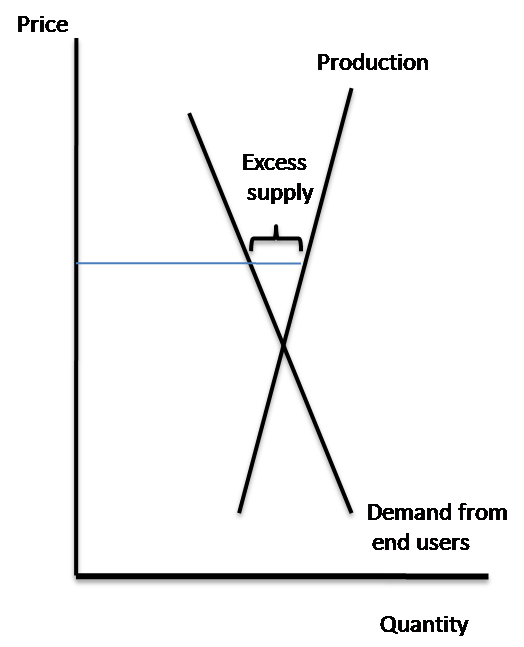
One of the things I find puzzling about the whole oil market discussion is how complicated people seem to make it. They get all wrapped up in stuff about forward markets, hedge funds, etc., and lose sight of the fundamental fact that there are only two things you can do with the world’s oil production: consume it, or store it.If the price is above the level at which the demand from end-users is equal to production, there’s an excess supply — and that supply has to be going into inventories. End of story. If oil isn’t building up in inventories, there can’t be a bubble in the spot price.
Now it’s true that oil supply responds very little to price, and that empirical estimates of the short-run price elasticity of demand, like this one, suggest that it’s low — say -.06. But even so, the math of a sustained, large bubble quickly becomes daunting. Say the demand elasticity is -.06, and that you believe that the current price is 40% above the level at which end-use demand equals supply. Then you have to believe that 2 million barrels a day is disappearing into secret hoards somewhere — secret, because it’s not showing up in the OECD inventory data. That’s a lot of oil. And bear in mind that people have been claiming that there’s an oil bubble for years
So my challenge to people who say there’s an oil bubble is this: let’s get physical. Tell me where you think the excess supply of crude is going.
Compelling point about moral hazard, courtesy of Credit Slips:
While moral hazard concerns are a real issue for any government aid to borrowers or lenders, its worthwhile remembering a major exception to moral hazard--third-party costs. As Larry Summers summarizes: When the fire department rescues people who start fires by smoking in bed, it creates a moral hazard for in-bed smokers. But no one gets exercised about moral hazard, in part because we know that fires can spread and burn down neighbors' apartments in "contagion" fires and that the in-bed smokers won't take care to insure their neighbors. That's what we're seeing in foreclosure crisis--mounting third-party costs to neighbors and local government. If the municipal government goes bankrupt [for readers in California, think about Vallejo], it affects everyone in the community--indeed, those who had to relocate because of foreclosure escape this consequence. Foreclosure is a real problem for everyone, not just those who get kicked out of their homes or whose investment portfolios take a hit.The point they're making is aimed mostly at people that think those who purchased homes they couldn't afford should just live with the consequences of their stupidity. However, it could be extended to those that think that the Fed did the wrong thing in "bailing out" Bear Stearns. The people that got bailed out at Bear Stearns weren't the employees or the shareholders. In fact, pretty much all of those guys got screwed. The people that got bailed out were Bear's counterparties, who didn't have much to do with Bear's business beyond funding it.

Lo and behold, the one time that I actually want to cash in my award flight, I find that it's gone. Hadn't I been using my card and extending the lifetime of my points like a good little boy? I called customer service and found out that JetBlue actually makes a distinction between points and awarded flights. The Amex Card extends the life of your points, but it will not extend the life of the awarded flights.
They referred me to their terms and conditions statement, where I found the following (apologies for the formatting):
4.1 A TrueBlue Award is issued automatically once a member has accumulated 100 points in the Program. The TrueBlue award is composed of 2 (two) TruePasses. Each TruePass is valid for 1 (one) one-way flight. Members will be notified of the award via e-mail and details can be found at the member's personal site at www.jetblue.com/trueblue. Notwithstanding the notification of awards via email, the member remains responsible for maintaining a current email, as JetBlue shall not be responsible for award notifications that are undeliverable.Now, you can interpret this to say that the only thing that the Amex Card specifically extends is the expiration date on TrueBlue Points. Without any sort of legal consultation, I would be pretty hesitant to go to court about any of this. However, from a consumer perspective, I think there's ample room for confusion.
4.2 TrueBlue Points may be redeemed for Award Travel by calling (800) JETBLUE or online at jetblue.com/awards. Award Travel is redeemable pursuant to the applicable redemption awards as posted on the JetBlue website or as otherwise issued by JetBlue. Once Award Travel is booked, it may only be changed before scheduled departure by calling (800) JetBlue and paying a $100 change fee. Award Travel may not be cancelled and TruePasses that are not flown will be forfeited and will not be re-deposited into your TrueBlue Account.
5.1 Except as may otherwise be provided for Holders of the JetBlue Card from American Express as set forth in paragraph 7.4, POINTS EXPIRE ONE YEAR AFTER THEY ARE EARNED AND TRUEBLUE AWARDS EXPIRE ONE YEAR AFTER THEY ARE ISSUED. Award Travel must be booked for travel available at or before the time of Award Travel expiration.
7.4 The expiration date of all TrueBlue Points in TrueBlue Membership Account's for Holders of the JetBlue Card from American Express will be extended to be 1 year from any date you have a TrueBlue point credited to your TrueBlue Membership Account from one of the following activities: (1) Using your JetBlue Card Account for an eligible purchase (as defined in your American Express Cardholder Agreement), or (2) flying a JetBlue flight segment that is paid for with your JetBlue Card Account. Eligibility and timing are basepon the date the TrueBlue point is credited to your TrueBlue Membership Account from one of the above qualifying activities.
I think the biggest issue is that nowhere does it explicitly state that once your points are converted into awards, they are considered as being in an entirely different category, subject to different treatment. This is especially important, as no other airline that I know of even has such a distinction.
Moreover, the phrasing in the terms and conditions leaves a lot of ambiguity as to whether or not these things should be treated differently. For instance, section 4.2 would lead one to believe that you are in fact redeeming points for award travel, not a separate category of awards (e.g. the TrueBlue Award or TrueBlue Pass mentioned in section 4.1). Section 5.1, while at least citing Points and Awards separately, states that expiration treatment of both points and awards may be different for AmEx cardholders. At this point, any reasonable consumer would be hard pressed to see what the difference between these categories is and why one should be protected via AmEx usage and another should not. Given the lack of a strict definitional framework, the meaning of section 7.4 seems much more open to interpretation.
Anyway, I have clearly spent way too much time thinking about this. Let's just leave it at me being pissed at JetBlue.

1) Threaded discussions - When you want to leave a comment that is actually a reply to someone else's comment, you click on the reply link and the comment/reply is indented right under the original comment. On any comment thread/discussion with a lot of action, this is absolutely necessary to make sense of the discussion. I am shocked that a popular blog like Techcrunch doesn't have this feature in its comments. Certainly it's possible for commenters to use an @sign to signify a comment that is actually a reply, but threaded discussion is so much better.I really only have about 10 regular readers on this blog, so the marginal benefit of installing Disqus has been pretty weak. But, if I did have a real audience, I bet it sure would be neat.2a) Email Replies - Disqus emails every comment to the blogger. If the blogger wants to reply to the comment, he/she simply replies to the email and it is posted as a reply (with the indent described above). This feature, which I requested the day I met/saw Disqus for the first time, is the single best thing about Disqus and has transformed my blog comments because I can now participate in them in real time throughout the day as the conversation develops. This is a BIG DEAL.
2b) Email Replies for Commenters - It works the same way for commenters. If you leave a comment in Disqus and have given Disqus your email address, you will get an email when anyone replies to your comment. You can reply to that just like the blogger can. This is also a big deal and leads to much more active commenting and replying - ie discussion.
3) Shared profiles. As more and more blogs add Disqus (over 10,000 at this point), the profiles that commenters create in Disqus are shared across blogs. This is an important network effect that benefits the blogger and his/her community. For example, if you have a blog that is read by a similar audience as my blog, and you add Disqus to your blog, most of my commenters will already be recognized by Disqus the first time they show up in your comments. They don't need to set up a new profile. They''ll have the same avatar/icon and identity.
Also, there's a greasemonkey script that brings disqus comments and commenting right into Google Reader. You can get it here.
I was standing in the elevator today, with a copy of Time announcing that the "winner" of the Democratic primary is... probably going to be Barack Obama. My downstairs neighbor Jonathon saw this cover and noted that he likes Obama a lot, but he's been around the block a couple and he's seen this "Hope" thing fizzle out time after time.
I would just like to comment on that. I am not supporting Obama because of his message of hope. All of this "Change we can believe in" and "Yes we can" business is just advertising to me. What's more important is that he actually treats voters (for the most part) as if they are intelligent people that capable of making decisions for themselves. I am incredibly tired and disgusted with politicians that essentially treat elections as popularity contests - smearing their opponents because of their race, gender, passing association with certain people, or phrases taken out of context, and essentially putting bullshit at the center of the political stage, rather than a substantive discussion about what is actually wrong with our country and how it can possibly be fixed.
So for me, this primary and the upcoming election is not about hope. It's about rejecting a set of actors (and I am looking squarely at the media and the politicians that play by their rules) who consistently make molehills into mountains and mountains into molehills.
Jon Stewart never ceases to amaze me. He has John McCain on his show and he asks him the following question, straight up:
"Will you take the opportunity right now to repudiate and denounce President Bush?"
To which, John McCain gets up and tries to flee the stage (as a joke).
Seriously though, I know that Stewart is a Democrat, but I don't know if I've ever seen him ask as tough of a question. To his credit, McCain artfully dodged the question by acknowledging that Bush's poll numbers suck and he'll have to run his campaign in his own way.
I will say that one of the most embarassing things that McCain said is that he views Al Qaeda as basically being transcendent evil, without any sense of individualism. Moreover, he will be "their worst nightmare." I couldn't think of a more simplistc, black and white way of thinking of the world.
Ok, back to work.
Every time we have a primary, my traffic numbers roughly double. Why? Because of traffic to a post that I wrote a long time ago about Obama being a smoker. Here's what I had to say:
I would be pretty disappointed if this ever became an issue, though. There are so many more important criteria to think about (e.g. positions on the environment, Iraq, taxes, religion) that if this one actually gains traction, then my faith in democracy as a political system will drop by about five points.Thankfully, it doesn't seem to have been an issue. Last that I heard, he'd quit the habit (bravo). However, I find it interesting that despite this, enough people are conducting searches about him smoking (example search terms include: "obama smoking" or "barack obama + cigarettes") that they are somehow finding their way to my blog.
I don't think there are many people reading this blog that actually drive, but for those of you that do, you should check out the following link on How to Get Better Gas Mileage. I wouldn't say that any of the content is particularly earth shattering, but it's interesting to see everything all in one place. Here's a quick sample:
Apologies for the crap formatting, Mahalo apparently isn't very good for the cut/paste.Watch Your Speed
- Try to keep your driving speed at or below 60 mph. Driving faster than 60 mph can significantly decrease your gas mileage. While this may be tough for some of you speed demons out there, it helps to think about this fact: You will end up paying an extra $0.20 per gallon for every 5 mph above 60 that you drive.[1] Add that up and you've got a pretty little chunk of change that you're wasting in order to get somewhere a little bit faster (not to mention all those speeding tickets).
Monitor Tire Pressure
- One simple thing that you can do in order to improve fuel efficiency is to always keep your tires inflated to the correct level. Tires that are low on air are harder to roll and require more work from your engine and more gas consumption[3]. Make sure that you check your car's tire pressure every time you fuel up (most gas stations have an air pump that customers can use). If you're unsure about how much air to put in your tires, check the owner's manual to find out the recommended psi for your specific vehicle.
 There's been a little bit of a flap about Clinton and McCain advocating temporary reductions in gas taxes. Key questions include whether or not it's a good idea (consensus being that it's not) and whether or not it's a big deal (consensus being that it's not). Here's a mish-mash of material putting everything in context. The following blurb from the WSJ concisely sums up the problem:
John McCain and Hillary Clinton want to send cash-strapped consumers on holidays from the federal gasoline tax. But the law they can't rewrite -- the law of supply and demand -- suggests it would backfire. Lower taxes would encourage people to drive more, meaning more demand that would push prices higher again.Here is David Brooks's account of Hillary Clinton being interviewed by George Stephanopoulos, with italics added:What the U.S. really needs, if it seeks a real fix to its energy-consumption problem, is less demand, not more. Mr. Market says there's a simple way to do that: Jack up the gas tax. Don't lower it.
Economists call it a "Pigovian Tax," in honor of English economist Arthur Pigou, who early in the 20th century examined economic activity that hurts innocent bystanders. To stop behavior that's not in the public good, you tax it more, not less.
Keep in mind that Paul Krugman has been one of the most vocal critics of the Bush presidency. He has also been one of Hillary's most ardent supporters in her long and protracted battle with Barack Obama. Here is Krugman's take on the gas tax issue:She peddled her sham gas-tax holiday and repeated her attempt to blame Indiana’s job losses on outsourcing and Nafta. Stephanopoulos asked her to name a single economist who thinks a tax-holiday plan would work, and the daughter of Wellesley and Yale took the chance to shove the geeks into their lockers: “I’m not going to put my lot in with economists.”
When Stephanopoulos pointed out that Paul Krugman, a Times columnist, has raised doubts about the plan, Clinton lumped Krugman in with the Bush administration and said she wasn’t going to listen to the people responsible for the last seven years.
Finally, to cap off this incredibly long post, here's conservative Harvard economist/textbook pimp Greg Mankiw:Hillary Clinton’s proposed gas tax holiday is not, in my view, a good idea. But the furor over what is, when all is said and done, a small and temporary policy proposal is entirely disproportionate. What’s going on?
Part of it, clearly, is the fact that many people in the media really, really want Obama to win and Clinton to lose — read Kurt Andersen — and have seized on the gas tax as their latest proof that she is ee-ee-vil.
But there’s also something going on with economists, a phenomenon I recognize wearing my other hat: the tendency to place excessive weight on issues where professional judgment differs from lay opinion....
Economists really do know something about tax incidence that the laity don’t. So when a presidential candidate says something that conflicts with economistic wisdom, it becomes THE MOST IMPORTANT ISSUE EVER. Except, you know, it isn’t.
Many economic issues (e.g., health care, corporate taxation, the trade deficit) are vastly complicated, with experts holding a variety of opinions. When candidates disagree, it simply means that each is siding with a different set of experts, and it is hard for laymen to figure out which set of experts is right. By contrast, the gas tax holiday is not nearly as complicated, and the experts speak with one voice.That pretty much sums up everything that I think I would ever need to know about this issue. Let's hope it gets put to bed.
Why, then, are candidates proposing the holiday? I can think of three hypotheses:
Ignorance: They don't know that the consensus of experts is opposed.
Hubris: They know the experts are opposed, but they think they know better.
Mendacity with a dash of condescension: They know the experts are opposed, and they secretly agree, but they think they can win some votes by pulling the wool over the eyes of an ill-informed electorate.
So which of these three hypotheses is right? I don't know [uh huh], but whichever it is, it says a lot about the character of the candidates [by which he means Clinton and McCain, as Obama has derided the gas tax as being political pandering].
I have nothing against the Macbook Air (other than some of the frustrations I pointed out earlier), but I found the following video to be somewhat humorous.
Haven't had much time to be in touch recently, but there's definitely a lot of interesting stuff kicking around these days. Definitely seeing more about peak oil these days, to the point where James Kunstler is appearing on the Colbert report and looking really, really not funny. I've also been thinking a lot about the "free content" model and whether or not it's slowly killing the media.
All that being said, I'm just going to drop in a quick link from the Big Picture that would be super cool:
Link to the full article from Newsweek here."But the loudest chatter is about Bloomberg, whose fortune—based on his stake in financial-information giant Bloomberg LP—Forbes magazine pegs at $11.6 billion. In a farewell column in January marking his retirement, Journal managing editor Paul Steiger touted the possibility of a friendly Bloomberg-Times merger. In NEWSWEEK interviews last week, a member of Bloomberg's inner circle confirmed that the mayor's confidants and closest associates are, in fact, encouraging him to explore the idea. The Bloomberg source wasn't authorized to publicly discuss the matter and, as a result, insisted on anonymity. Through a spokesman, Bloomberg declined to comment. According to the source, the proponents of the merger are appealing to the mayor's sense of "civic-mindedness," arguing that he is best suited to take the publishing company private to "help protect the brand" in the wake of relentless shareholder assaults. "It is clearly a brand that Bloomberg could help preserve and that he cares about immensely … and could pay a competitive price" for, says this person.
Murdoch, for one, sees a natural fit between Bloomberg and the Journal's uptown rival. Bloomberg, he notes, has pledged to remain a force in national public life after leaving New York's city hall at the end of next year. To that end, owning the Times would help immensely, Murdoch reasons. Yet the prospect of competing against a Bloomberg-owned Times appears to rattle him. "I wouldn't look forward to going up against him," Murdoch told NEWSWEEK, citing his "great respect for Bloomberg's business abilities."
Following the quote about frictionless media consumption, I wanted to say one more thing.
I used to like the Freakonomics blog. Levitt's posts I tend to find particularly interesting, Dubner is sort of whatever. I stopped reading them a while ago. Why?
A) Truncated RSS feed, which happened when they moved to the NYTimes
B) Bloated posting habits
In B, I'm referring to the fact that they've juiced up the number of posts that they produce on a daily basis. This is a case in which quality has a very clear inverse relationship to quantity. Before, the only stupid posts that I had to filter out were Dubner's. Since then, they've added a random unnamed editor (Melissa Lafsky?) that posts random links and articles, some other economist (who might actually be reasonable, if I bothered to read his posts) and Jessica Hagy of indexed fame. I now have to jump many more hoops to get to the content that I want. Subsequently, I've stopped paying attention and drifted off to other sources.
WSJ, consider this your official warning.
Overheard by Felix Salmon at Portfolio.com:
Damn straight. When Salmon says "broadly applicable," I think he should double down and say that it's "super directly applicable" to any media content available on the Internet. I'm basically drowning in Internet media these days. Much like a ruthless college admissions officer, the spread in my selection criteria is narrow to the point where I'm looking for just the slightest of reasons to off each of the many candidates for my attention.Eric Feng of Hulu, on the digital innovation panel:
Media is an impulse business. It's foolish to expect that the user is going to climb mountains and cross hurdles to get to that content.
This is very broadly applicable. Clearly it's the driving force behind Hulu, which is delivering television content to people when, where, and how they want it. But it's also the reason why wsj.com should go free, it's the reason why RSS feeds should never be truncated, it's the reason why people are buying music on iTunes rather than at Amazon.
More on the US not being in a recession
View Comments Published by Panda on Wednesday, April 30, 2008 at 10:16 AM
Snippet from Paul Krugman on recessions:
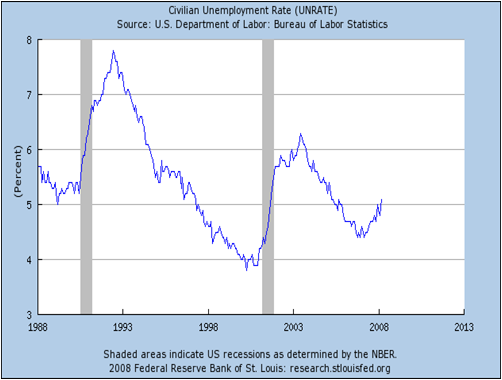
So, GDP was up slightly in the first quarter. Does that mean that we’re not in a recession? The correct answer is, who cares?
The NBER Business Cycle Dating Committee defines a recession as
a significant decline in economic activity spread across the economy, lasting more than a few months, normally visible in real GDP, real income, employment, industrial production, and wholesale-retail sales.
Broadly speaking, that means that the economy is only considered to be in a recession when everything is going down. Historically, that hasn’t been a problem, since most recessions have been “V-shaped”: everything plunges, and then everything springs back, so there isn’t much ambiguity about whether the economy is worsening or not.
But since the mid-1980s we have been having “U-shaped” recessions in which the upturn is slow and weak. As a result, things that matter to a lot of people — like the unemployment rate, shown above — keep getting worse long after the official recession period, indicated by the shaded areas. Officially, the recession of 1990-91 was long over by the 1992 election, but people were still very worried about the economy, stupid. The 2001 recession officially ended in November of that year, but the job situation kept getting worse until the middle of 2003.
The point is that the official definition of recession has become delinked from peoples’ actual experience. Right now, we’re in an economy with deteriorating employment and incomes, collapsing home prices, and business retrenchment. Is it also an economy in recession? Who cares?

Also, a post from The Big Picture on how this will impact GDP growth in the current quarter:
At 8:30am, we get the advance GDP data from BEA. Consensus is for a marginally positive data point -- 0.3%. This will follow Q7 2007 of 0.6%.
In terms of debunking the misleading data stats, today is the day where the rubber meets the road. Why? Well, if the official inflation data was reported in a way that was more reflective of reality, Q4 last year would likely have been anywhere from 0.75% to 1.5% lower (if not more), sending it into negative territory.
The same will be true for today's GD data point, with the probable overstatement enough to keep it marginally positive or flat.
Why does inflation matter so much to GDP? Gross Domestic Product (GDP) is the "broadest measure of aggregate economic activity and encompasses every sector of the economy." If you want to know understand how weak or strong an economy is, GDP is where you begin. But, you need to determine how much of GDP is nominal, and how much is real (i.e., after inflation growth).
Consider an economy that sold $100 worth of goods and services in one quarter. The next Q, it produced $110 worth. When determining the GDP of this economy, you want to know how much of those gains was additional output, and how much merely price increases. Its usually a combination of more widgets and higher prices, so if you want to know exactly how much the economy expanded, you need to know exactly how much inflation there was. Understate inflation, and you overstate growth.
If today's GDP is marginally positive, following Q4's marginally positive GDP data, then we officially will not be in a recession by the classic "2 consecutive quarters of negative GDP growth." This means that if the correct inflation deflator was built into GDP, we would have our two consec quarters.
Hence, for the reality based community, the recession will be officially here.
Of course, if you believe that actual inflation is running about 2.5%, then you should feel free to ignore this analysis.
I only watched half of American Idol last night, but I'm still predicting that the blonde goes home.
Nothing against her, but it just seems like the time's come for it to happen.

That's how Brad DeLong ends a significant number of his posts. But it's true. To a large extent, I feel like the press corps is gradually succumbing to a strategy of appealing to the lowest common denominator. In the US, that LCD is very, very low and perhaps getting lower by the day. To a large degree, it's why I've totally given up on primary coverage. It's also why some of Obama's rhetoric resonates with me. But I digress.
I may have given up on primary coverage, but I haven't given up on the meta-coverage. To that effect, I was heartened by the recent Op-Ed from Elizabeth Edwards in the NYTimes. Here are some selected passages:
FOR the last month, news media attention was focused on Pennsylvania and its Democratic primary. Given the gargantuan effort, what did we learn?Amen to Elizabeth Edwards. If only more opinion articles were dedicated to topics such as these, rather than the meaning and context of misspoken words, than I'd be a much happier consumer of MSM reporting.
Well, the rancor of the campaign was covered. The amount of money spent was covered. But in Pennsylvania, as in the rest of the country this political season, the information about the candidates’ priorities, policies and principles — information that voters will need to choose the next president — too often did not make the cut.
...
The problem today unfortunately is that voters who take their responsibility to be informed seriously enough to search out information about the candidates are finding it harder and harder to do so, particularly if they do not have access to the Internet.
Did you, for example, ever know a single fact about Joe Biden’s health care plan? Anything at all? But let me guess, you know Barack Obama’s bowling score. We are choosing a president, the next leader of the free world. We are not buying soap, and we are not choosing a court clerk with primarily administrative duties.
What’s more, the news media cut candidates like Joe Biden out of the process even before they got started. Just to be clear: I’m not talking about my husband. I’m referring to other worthy Democratic contenders. Few people even had the chance to find out about Joe Biden’s health care plan before he was literally forced from the race by the news blackout that depressed his poll numbers, which in turn depressed his fund-raising.
And it’s not as if people didn’t want this information. In focus groups that I attended or followed after debates, Joe Biden would regularly be the object of praise and interest: “I want to know more about Senator Biden,” participants would say.
...
Who is responsible for the veil of silence over Senator Biden? Or Senator Dodd? Or Gov. Tom Vilsack? Or Senator Sam Brownback on the Republican side?
The decision was probably made by the same people who decided that Fred Thompson was a serious candidate. Articles purporting to be news spent thousands upon thousands of words contemplating whether he would enter the race, to the point that before he even entered, he was running second in the national polls for the Republican nomination. Second place! And he had not done or said anything that would allow anyone to conclude he was a serious candidate. A major weekly news magazine put Mr. Thompson on its cover, asking — honestly! — whether the absence of a serious campaign and commitment to raising money or getting his policies out was itself a strategy.
...
A report by the Project for Excellence in Journalism and the Shorenstein Center on the Press, Politics and Public Policy found that during the early months of the 2008 presidential campaign, 63 percent of the campaign stories focused on political strategy while only 15 percent discussed the candidates’ ideas and proposals.
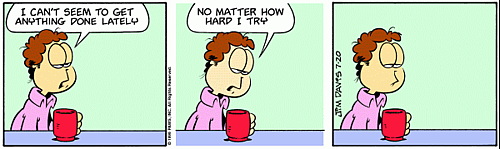
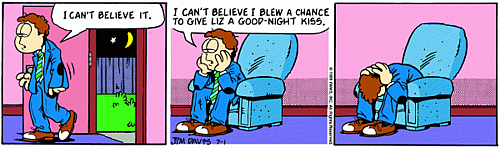
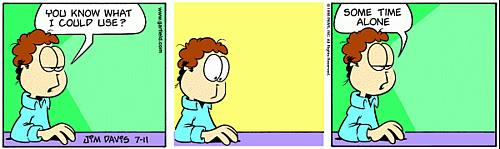
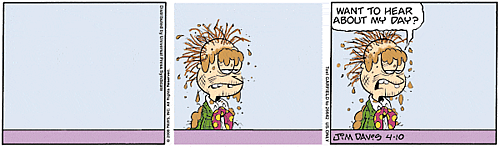
I totally stole this link from Sheena's blog, but it's awesome. It's a tumblog called Garfield minus Garfield, and it's pretty brilliant. Here's the tagline.
Who would have guessed that when you remove Garfield from the Garfield comic strips, the result is an even better comic about schizophrenia, bipolar disorder, and the empty desperation of modern life? Friends, meet Jon Arbuckle. Let’s laugh and learn with him on a journey deep into the tortured mind of an isolated young everyman as he fights a losing battle against loneliness in a quiet American suburb.Here are some pictures:
The following television shows make me want to put a hole in my head.
* Grey's Anatomy
* The Hills
* The Real World
* Desperate Housewives
* Etc.
There are some common threads running through these shows. The first and most obvious is that these shows focus on women. I don't think that this is the reason I hate them, but it's probably related.
The second and more relevant is that their stories focus excessively on the details of romantic relationships. With the fictional shows, these romantic relationships frequently become highly incestuous, with the end result being that everybody will, at some point, sleep with everybody else.
The third is that the characters in these shows tend to be extremely self-absorbed, to the point of total absurdity. The reality shows, in particular, tend to latch onto the more ridiculous ones and air as many minutes of their absurd behavior as possible. Even though not all of the people/characters are ridiculous, the fact that I would try to avoid most of these people in real life speaks volumes to me.
I happen to be sitting through a marathon session of these shows right now. I'm praying that the pain will be over soon.
For a while, there's been a long-standing debate within my family, started by my father. The question at the core of the debate is whether wine is priced higher because it is considered to be good, or if wine is considered to be good because it is priced higher. His contention is very much the latter, with my cousin, my mom and my girlfriend mostly favoring the former.
To be fair, there's a bit of definitional looseness around the concept of "good" in this case. My dad's position implicitly assumes that the quality of wine is entirely defined by its phenomenal characteristics, e.g. taste, smell, etc. This, combined with his contention about wine pricing, would thus imply that people that enjoy expensive wines are simply suckers with airs of pretention. However, it's entirely possible that some people also find value in the signaling that comes with the consumption of expensive goods, in which case, a bottle couldn't really be good unless it was expensive and people knew it. That being said, no one in our family really thinks about the debate this way. For the sake of our arguments, if a wine is good, it's good, regardless of the price or label.
The results from a recent study from Wine Economics lends some new evidence to this debate. This from the introduction:
In this paper, we use a large sample of more than 6,000 US blind tastings, compiled by food and wine critic Robin Goldstein. Blind tastings offer the opportunity to isolate the experience of the wine itself from psychological confounds related to its price, presentation or published expert ratings.The paper is short, but it has a lot of interesting results in it. For one, the study finds that so-called wine experts, i.e. those with training of some sort, do tend to like more expensive wines. One study reference that I thought was interesting was the following:
We investigate the relationship between price and subjective appreciation of wines, when the price is unknown to the tasters. Subjective appreciation is measured by overall ratings assigned to wines by individual participants.
Our main finding is that, on average, individuals who are unaware of the price do not derive more enjoyment from more expensive wine. In fact, they enjoy more expensive wines slightly less.
There is, however, some research expressing skepticism towards wine ratings and their use for the average wine drinker. According to Quandt (2007), many wine ratings do not actually convey any information, nor is there substantial agreement in ratings by experts. Consistent with this view, Weil (2007) investigates whether wine descriptions of experts actually convey any information to wine consumers. This is tested by having testers match wine descriptions to wines. In a similar setup to Weil (2001, 2005), tasters are asked to distinguish the odd one out of three different glasses of wine. Only about 50% of the participants can distinguish the odd one out, and of those that manage to do it, only about half can correctly match a wine critic’s description of the wine with the wine itself - which is no better than a random guess.
Random comment: WSJ on upcoming summer movies
View Comments Published by Panda on Friday, April 25, 2008 at 7:51 AMI'm not sure why I find this amusing. Actually, I do. It's because I think it's stupid. From the WSJ:
The summer of 2008 will feature an unusually deep bench of comic-book characters, including "Iron Man," "Hellboy II," "The Incredible Hulk" and the return of Batman in "The Dark Knight." The season also has heroic figures aimed at baby boomers ("Indiana Jones and the Kingdom of the Crystal Skull"); outsiders (Will Smith as a down-and-out guy infused with super powers in "Hancock"); conspiracy theorists (a new "X-Files" movie); and fantasy lovers ("The Chronicles of Narnia: Prince Caspian"). And moviegoers looking for heroines without special powers (but with outfits as stylish as those of any superhero) can check out the movie version of "Sex and the City."
..."Sex and the City" from Time Warner Inc.'s New Line unit, also hopes to tap into the heroic spirit of the summer. "These women are the ultimate female superheroes," says Michael Patrick King, who executive produced the HBO hit from which the movie sprang. " 'Sex and The City' was made to correct the myth that if you were single at a certain age, you were a leper. Its four characters are heroes to a lot of women; they run around New York, or Gotham -- but they have fancy shoes instead of capes."
I get what they're saying, but this is a stretch of pretty farcical proportions. If they had phrased it in any other way, e.g. females are also being given self-empowering fantasy schlock, then I wouldn't have given this passage a second thought. But trying to shoehorn characters that are almost exclusively concerned with sex and fashion (i.e. themselves) as heroes? Give me a break.
P.S. I happily admit to not being a fan of Sex and the City, and have only watched a bare handful of shows. If some avid fan happens to have evidence that disputes my view, I'm more than happy to be corrected.
In the last day or two, it's become clear that Murdoch's assurances about News Corp. keeping its hands off of the WSJ were a load of bullshit. There have been some minor changes, as reported by both the WSJ and the NYT. This from the latter:
This is troubling in and of itself. While I doubt that Murdoch is going to do to the WSJ what he did to the New York Post (i.e. turn it into a big freaking joke), he's clearly trying to use the WSJ as a platform for his conservative agenda. While I'm not entirely averse to the idea of having an ideological counterpoint to the NYTimes, I am averse to the fashioning of that counterpoint being executed by the man that is responsible for Fox News, which is now infamous for its willingness to ride blithely over a little detail called journalistic integrity, or more plainly put, factual accuracy. If Murdoch poisons that particular well, then he can kiss my subscription goodbye.Mr. Murdoch has said publicly that he wants to make The Journal more of a general-interest newspaper, to compete more directly with The New York Times, though he insists he will not diminish its coverage of business.
To that end, The Journal has increased its coverage of other areas, notably politics, and the bulk of its first section is being devoted to general-interest news. The front page has fewer business articles and fewer of the long, offbeat features that were a signature of the paper.
The biggest change to date has been the "resignation" of managing editor Marcus Brauchli. However, an article from Portfolio.com highlights the exact nature of that resignation.
So far, it sounds as if Murdoch has no compunctions about bending the contractual obligations of the deal to have his way with the paper.Constructive termination, or constructive discharge, is a legal concept meaning a change in an employee's working conditions of the sort that would cause any reasonable person to quit. It's been widely reported, including by me, that News Corp. did indeed engineer a "material change" in Brauchli's "duties or responsibilities." Once Robert Thomson was appointed as publisher, Brauchli ceased to be the top editorial voice at the paper, and was left out of major decisions, including the development of a culture section and the launch of a new overseas edition. Pre-Murdoch, such decisions would clearly have been part of his purview. In other words, Brauchli was demoted.
Then, to top it all off, Thomson and new Dow Jones CEO Les Hinton actually told Brauchli, earlier this month, that they'd prefer a managing editor of their own choosing.
Add it all up, and News Corp.'s claim that Brauchli "resigned" starts to look pretty vulnerable, legally speaking.

The biggest problem is that I'm a huge user of keyboard shortcuts and it's taking me a ridiculous amount of time to get used to the differences. Here's what's tripping me up.
* Lack of dedicated page up/page down buttons. Apparently, this is solely Air related.
* I have no idea how to page through tabs in Firefox
* I have no idea how to rapidly switch back and forth between windows
* Ctrl functions seem to be split across the option and command buttons
* I have no idea how to replicate Alt like functions
I'm picking things up through a slow, slow process of trial and error. I realize that I could probably go look it up online, but I figure this isn't my machine and I don't really want to get too used to it.

This from today's WSJ:
To tap Khurais, Saudi Arabian Oil Co., known as Aramco, has embarked on the most complex earth- and water-moving project in its history. It is spending up to $15 billion on a vast network of pipes, oil-treatment facilities, deep horizontal wells and water-injection systems that it calls "one of the largest industrial projects being executed in the world today."
Moreover, with the project, Aramco is dipping into one of its last big basins of oil. After Khurais, Saudi Arabia will have only one known mega-field left to fully develop, the even more challenging Manifa field, offshore in the Persian Gulf. Much of the kingdom's reserves beyond these lie either in aging fields or smaller pockets.
"Khurais and Manifa are the last two giants in Saudi Arabia," says Sadad al-Husseini, a former Aramco vice president for oil exploration. "Sure, we will discover dozens of other smaller fields, but after these, we are chasing after smaller and smaller fish." [That doesn't sound good]
...
But Saudi Arabia is under pressure to ramp up its output as the world scrambles to keep pace with rising oil demand, which the International Energy Agency predicts could hit 99 million barrels a day by 2015, up from 87 million barrels a day this year [Ok, so demand is going... up]. With output declining or flat in Mexico, Venezuela, the North Sea and Russia, all eyes are on the Saudis to fill much of the gap, even as oil demand soars within Saudi Arabia itself. [And production is going... ?]
 The graphic above is of Saudi's oil fields and it seems to give a pretty good indication of the relative sizes of the remaining oil fields.
Now, I haven't seen enough info out there to indicate that production has peaked, per se, but the tone of these articles definitely isn't instilling a great deal of confidence.

An e-mail from Arthur and a few articles have started juicing up my interest. The current meme that's interesting me is whether or not we're looking at a "peak oil" situation. That, according to wikipedia, would be:
Peak oil is the point in time when the maximum rate of global petroleum production is reached, after which the rate of production enters its terminal decline. If global consumption is not mitigated before the peak, an energy crisis may develop because the availability of conventional oil will drop and prices will rise, perhaps dramatically.There are two questions that are up in the air at the moment. The first is if we are actually reaching peak oil. The second is if that's actually a problem, or if it's more of a Malthusian issue that can be dismissed due to mankind's ability to innovate its way out of resource constraints.
To keep the length of this post down, I'll address my thoughts on those two questions in separate posts.
Updated predictions:
* Either Jason Castro or Brooke White is going home tomorrow. Probably Brooke, since she hasn't had a good performance since the last time I wrote about American Idol.
* I'm still pegging David Cook to win it all. The other contestants don't really matter that much
I'm still not following the primary (although I seem to be hearing a lot about the words "bitter" and "cling" of late), but that hasn't stopped other people from sending me bits and pieces. One of the key things that's drawn me to Obama has been his willingness to cut the crap and talk straight, much like you might see American presidents doing in movies such as "The American President." What follows is an example of exactly that, taken from last night's debate. Hat tip to my friend Arthur:
[Question about his relation to William Ayers of the Weather Underground]This is exactly the kind of thing that I wish would happen more often in our country's political discourse. Of course, I wish that it would consequently be followed by embarassed apologies from the people that wallow in this kind of sludge on a day-to-day basis. Unfortunately, that never seems to happen.SEN. OBAMA: George, but this is an example of what I'm talking about.
This is a guy who lives in my neighborhood, who's a professor of English in Chicago, who I know and who I have not received some official endorsement from. He's not somebody who I exchange ideas from on a regular basis.
And the notion that somehow as a consequence of me knowing somebody who engaged in detestable acts 40 years ago when I was 8 years old, somehow reflects on me and my values, doesn't make much sense, George.
The fact is, is that I'm also friendly with Tom Coburn, one of the most conservative Republicans in the United States Senate, who during his campaign once said that it might be appropriate to apply the death penalty to those who carried out abortions.
Do I need to apologize for Mr. Coburn's statements? Because I certainly don't agree with those either.
So this kind of game, in which anybody who I know, regardless of how flimsy the relationship is, is somehow -- somehow their ideas could be attributed to me -- I think the American people are smarter than that. They're not going to suggest somehow that that is reflective of my views, because it obviously isn't.
Just came across an arstechnica article about Novint, which apparently produces fancy hardware peripherals for gaming consoles. I still have no idea what they do, other than it involves the word, "haptics," so it's something about touch. What I found intriguing was the way that they approached a particular problem in the peripheral industry, which was articulated as:
New peripherals always have an uphill battle in the market; those on both the PC and the gaming consoles that have managed to take off always have strong games attached. Dance mats are inseparable from Dance Dance Revolution, the guitars and drums for Rock Band had one of the most hyped rhythm games and a proven track record to bank on, while expensive flight sticks bring the promise of a more realistic experience with a variety of different flight simulations. So what do you do when your main product is a $190+ haptic device? The first step is getting people to try it, and the second step is making enough great games available for it to get people to bite. The best peripheral is worthless without a solid software library.So, the problem is that their hardware product is nothing without good software to back it up. Here's what Novint is doing about it. Italics added.
"Typically what we do is we license from a publisher or developer the rights to a game, and we license it in a field of use, meaning we can only use it in a specific area," Anderson explained. "The area we work out with them is the 3D Touch field of use. So when we see we have the tough right, we saying we're licensing the 3D Touch field of use. What that means is we're licensing the ability to use touch in an existing game."This is why Novint may become one of the most powerful players in the field of gaming haptics. The company has created a brand-new way for developers and publishers to monetize their franchises, and it costs the companies nothing to give it a try. Novint is offering publishers like EA a brand new way to promote their products, a new audience in Falcon users that may be hungry for triple-A content, and porting the games to the Falcon as a platform will cost them nothing.
Imagine someone offering you a nice check for something you didn't know you could sell, and you start to see how intriguing this idea had to have seemed for EA. "We're buying the sleeves off their vests," Tom tells me, and I laugh, but it's an apt image. Novint will sell the games through its web site for $29.95, but if you already own the title, you can pay $9.95 for the haptics update.
"We go to a company that owns a game, and we say we want to acquire the 3D touch rights to the game. Sometimes the first reaction we get is 'You want to buy what now?' We're buying something from people they didn't even know they had," Anderson said. "We say we'll pay an upfront fee for the touch rights, so Novint is the one taking all the risk, and we tell them that we'll do the integration with the touch; there is no cost for [them].
That's definitely going in my book of clever strategic plays. I hope it pays off for them.

Alberto R. Gonzales, like many others recently unemployed, has discovered how difficult it can be to find a new job. Mr. Gonzales, the former attorney general, who was forced to resign last year, has been unable to interest law firms in adding his name to their roster, Washington lawyers and his associates said in recent interviews.I think this is a pretty rich opportunity for schadenfreude, as Gonzales represents a lot of things that seem to be wrong with the Bush administration, e.g. cronyism, egregiously partisan behavior, obstruction of justice, etc. Even so, it's not clear to me that this is the type of thing that the NYT should really be reporting on.
He has, through friends, put out inquiries, they said, and has not found any takers. What makes Mr. Gonzales’s case extraordinary is that former attorneys general, the government’s chief lawyer, are typically highly sought.
One more round of weekend cooking. I made Fuchsia Dunlop's version of dan dan mian, a semi-spicy noodle dish whose contents seem to change drastically from restaurant to restaurant. Wikipedia defines dan dan noodles as
...a classic dish of Chinese Sichuan cuisine. It consists of a spicy ground peanut and sesame sauce over noodles, usually very garlicky, and often served with cold sliced cucumbers.Well, the dish that I made had no peanuts in it. In fact, the recipe didn't call for anything that remotely resembled a peanut. It was mainly ground pork, ya cai (pickled vegetables, a bit on the salty side), various soy sauces, chili oil and a generous amount of ground Sichuan peppercorn. Here's how it came out, just before mixing:The same sauce is frequently served over poached chicken (called Bon Bon or Bong Bong Chicken), and on steamed, meat-filled dumplings in another Sichuan dish called Suanla chaoshou.
The name is also used for another dish that eschews ground peanuts.
A variety of English spellings are used. The first word may be either Dan, Dun, or Tan. There may or may not be a hyphen between the first two words. The last word may be Mein, Mian, or Noodles. The name refers to a type of carrying pole (a dan dan) that was used by ambulatory vendors who sold the dish on the streets.
 And after mixing:
 It came out ok, but as Pudge put it, the flavoring was a little "monochromatic." I'm not sure why she chose to put it in terms of color, but the gist of it was that the flavor was pretty much overpowered by the salt. The numbing flavor of the Sichuan peppercorns had a subtle effect, but that was about it. I'm guessing that next time, a bit of ground peanut or something might make it a little more interesting.
The following graph plots actual earnings (red) versus the forecasts of equity analysts (black).
Wow. On the whole, these guys are worthless.

I got my cook on today. It took me a little longer than expected to get all the ingredients I needed to start rolling out the promised Chinese goods. Part of it was that it apparently takes a week for things to be delivered from Brooklyn to the Upper West side. Part of it was that Western grocery stores in the UWS don't seem to carry ground pork(!). Must be a Jewish thing. And part of it was that I still needed one or two additional ingredients, which required me going all the way down to China town.
Today, all the pieces came together.
The first dish that I made is generally referred to as "Ants climbing up a tree," or ma yi shang shu. It's generally called that because as you pick up the noodles (which are kind of hard to see, due to blurriness), the ground pork tends to stick to the strands, resembling ants climbing up a tree. It was pretty quick and came out with the right balance of meat, noodles, and spice, at least for me. Pudge has no ability to eat spicy food, which is pretty surprising considering her upbringing.
The process was relatively easy, as are most of the recipes that I've seen in the book. What struck me was that the dish actually requires you to reduce chicken stock, which I wouldn't have expected. I always figured that you just have the noodles mixed up with spicy ground pork and you're good. Instead, you add chicken stock to the whole mix at the very end and then reduce it, allowing all of the flavors to mix together.
The other dish that I made was a simple kung pao chicken, or gong bao ji ding. I changed the recipe a bit, because I'm not such a big fan of peanuts in my food. I also reduced the number of chili peppers in the dish, in order to better suit Pudge's palate..jpg) The dish came out pretty well, although probably not as well as the first one. The peppers probably cooked a bit too long and ended up being a bit darker than I would have wanted. I should probably have kept the garlic, ginger and scallions in larger, chunkier pieces. I may have also put in too much corn starch, making the sauce a bit thicker and clumpier than it should have been. Also, the dish's color came out much browner than expected, making it into more of a "chicken in strange brown sauce." Still, it tasted pretty good in the end.
The dish came out pretty well, although probably not as well as the first one. The peppers probably cooked a bit too long and ended up being a bit darker than I would have wanted. I should probably have kept the garlic, ginger and scallions in larger, chunkier pieces. I may have also put in too much corn starch, making the sauce a bit thicker and clumpier than it should have been. Also, the dish's color came out much browner than expected, making it into more of a "chicken in strange brown sauce." Still, it tasted pretty good in the end.
So far, I've made these dishes and a dish of dry-fried string beans with pork (gan bian si ji dou). Regrettably, I didn't take a picture at the time, but they generally look something like this.
This is a chart from Dani Rodrik's blog that was making the econ blog rounds this week. I think the point that it's trying to make is pretty straightforward, but whether or not you believe it is a different question.
The clearly depicted story is that under Democratic presidents, not only has real income growth been significantly more equitable across income segments (as might be expected), but it has been higher overall, even for those in the top income brackets.
There are a host of factors that may be at work here. I will let Rodrik explain which factors are relevant:
Bartels [Princeton professor that produced the chart] shows in his book that this difference is not a statistical artifact or a fluke. It is not the result of Democrats coming to power during better economic times, or of Republicans reining in the unsustainable excesses of Democratic administrations they replace. (It turns out that the same pattern prevails even when a Republican president is succeeded by another Republican.) These numbers are real and they are the outcome of partisan differences in policy. So if you are one of those who have bought the story that income distribution is the result of pure market forces and technological changes, with politics playing no role--think again.There's another chart out there somewhere that shows that strangely enough, avg. real income growth is higher under Republicans during election years. I'll see if I can find it later.
It's been a busy week for me, so apologies for the radio silene.
I've been pretty good about completely ignoring the primary for a while, particularly as nothing actually seems to be happening. However, it does make for some light reading on a lazy Saturday. Data snippet for today comes courtesy of the NYTimes:
So... racists, unthinking goosesteppers, chauvinists and uninformed idiots tend to dislike Obama. Not to put too fine a point on it.

(Note: this is very different from saying that those that dislike Obama are racists, unthinking goosesteppers, etc.)