I'm not an economist, but I do like reading blogs from economists. One of the things that I've picked up on from some posts has been the idea that China is not a source of inflation, when you look at the data. Here's a clip from the WSJ:
“Imports constitute around 15% of U.S. GDP and around 13% of that comes from China,” the authors write in an article in the latest issue of China & World Economy, an English-language journal published by the Chinese Academy for Social Sciences. On their back-of-the-envelope calculation, that means a 1 percentage point increase in China’s inflation rate should lead to an increase in U.S. inflation of 0.02 to 0.03 percentage points. Yet their comparison of historical price trends in China with those in both the U.S. and Japan found the actual effect was even smaller.And here's one from Paul Krugman:
In fact, overall, the US spends a little more than 2 percent of GDP on Chinese goods. That’s dramatically more than in the past. But it suggests that if Chinese prices rise 10%, the overall cost of living here would rise by less than a quarter of a percent. Every little bit hurts, but this isn’t as big a deal as a casual reading of this article might lead you to think.Fine, so if the prices of Chinese imports go up, the total effect in the US won't be that big. But, what about the effect of China on the price of commodity inputs? Here's a graph of real oil prices in Feb. 2008 dollars.
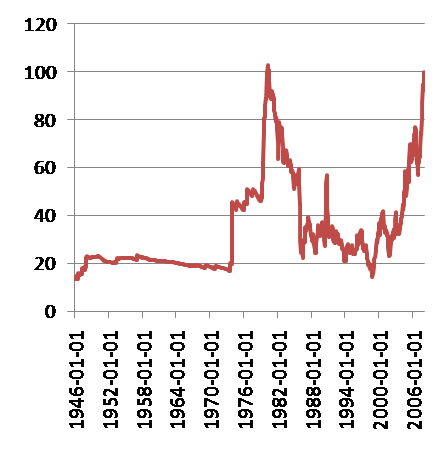 Now, what I've been reading is that the run-up in oil prices can be partially attributed to Fed Monetary policy. But the other thing that could be driving it is huge demand growth coming from China, and to a lesser extent India. I have no way of telling which of these two factors is playing a larger role. However, let's say that factor #2 is in fact big. Wouldn't that subsequently mean that China is playing a significant role in global inflation? Someone enlighten me.
A couple days ago, I had a thought about food trends. The thought was that food staples have essentially been commoditized, due to the manufacturing processes used to achieve scale. This has opened the door for higher end, branded food products that trump up their home-grown processes. Hence Berkshire pork, slow-churn ice cream, Niman Ranch bacon, artisanal cheeses, fresh hand-made pasta made from durum, and all that jazz. My thought was that something like that would soon happen to butter, as there is clearly room for differentiation in both the process (e.g. freshness of the ingredients, churning style) and the perceived quality of the output.
Lo and behold:
ANNE SAXELBY had what she calls an “aha moment” a couple of years ago when she drove upstate to try the cultured butter made by Evans Farmhouse Creamery in Chenango County. Ms. Saxelby, who owns Saxelby Cheesemongers in Manhattan, said that for all the butter she had eaten in her life, “I had really never had butter before — this is butter.”
More and more people across the country are being treated to the same aha experience as they find a burgeoning variety of fresh dairy products made in small batches on little farms and in small creameries. And it’s worth the extra money.
Of course, anecdotes in the Times do not a trend make. But still, it's always fun when something that you were thinking about shows up in print within a couple of days.
Speaking of anecdotes, from the same article:
Nancy Nipples started the Pike Place Market Creamery in Seattle 30 years ago, selling milk, butter, cream and the like to help local independent dairies... (Nancy Nipples is the name she uses to sign checks; her full name, taken after a divorce, is Nancy Nipples the Milkmaid.)Her name is what?!
Link courtesy of Pudge
From Ars Technica:
Effective immediately, Toshiba will ramp down shipments of HD DVD players with an eye towards stopping them altogether by the end of March. The company left open the possibility of continuing to ship laptops with HD DVD drives installed, but it's difficult to believe that there would be any demand for them
Glad I'm no longer one of those early adopter types.
As many of you might have guessed from the recent flurry, I'm a touch bored these days. There hasn't been a lot of project flow and I'm still waiting to hear back from some people on things that I've sent out. In any case, here's an interesting factoid that I just found.
I've been going through consumer bankruptcy filings recently and have been astounded by the levels of credit card debt that show up on some (but certainly not most) debtor's schedules of assets and liabilities. I've seen a bunch of cases with upwards of $60,000 of debt for a single debtor, a few with over $100,000, and the current record holder is $175,862.27. Yes, that's right, $175,862.27. That's larger than a lot of mortgages.Yowch.
This debt was incurred on 25 cards from 12 different lenders, all major national financial institutions. No less than 9 of the cards and $80744.16 of the debt were for one lender, Bank of America. The debtor's annual post-tax income is listed at around $85,000, and the debtor has been in her current job and industry for a while.
Link.
This is about as clear of a picture of the subprime mortgage mess that you'll ever get. Stick figures included:
[Link via The Big Picture]

This post was inspired by a recent post at RW/W about Moody, a 3rd-party app for iTunes that allows you to do "mood-tagging." Basically, it just organizes your songs into playlists for you, which I think is pretty useless. But I think the problem it's trying to solve is one that would make my life a lot easier. Over the years, I've amassed a pretty sizable collection of music. Organizing it in a clean, understandable fashion has definitely been one of my biggest frustrations.
There may be some of you out there that don't bother to organize your music and wonder why I would even care to do so. The primary answer is for browsability. I have so much music that I frequently forget what I do/don't have, and find myself often rediscovering albums. The holy grail of organization would make this process a lot easier.
I use iTunes as my primary music player. The search function is great. I like that it keeps track of what I've listened to both on the computer and on my iPod/iPhone. I've rated a ton of songs and I think that makes it a lot easier for me to refind songs that I like. And I think that the browser is a lot easier to manage then a bunch of folders on a hard disk, as it simultaneously cuts across the three axes of music-browsing - artist, album, and genre. You could toss year released in there, but I think that's a bit tougher to use.
For browsing purposes though, genre really seems to be the only way to go, for a couple reasons. First and foremost, given a sufficiently large selection, there will be too many artists and albums. Secondly, except for a few rare outliers, there won't be enough musical variety within one artist/album, meaning that you have to keep switching around if you want to put together a playlist of any variety. Thirdly, artists/albums are pretty concretely defined categories, meaning that the contents of these categories aren't really that subject to change.
The problem with using genres for browsing is that it's a huge pain to label things. You can only apply one genre to each song! That's pretty useless in my book. A lot of good music cuts across genres. Even bad music cuts across genres, to be honest (e.g. Diddy-influenced fusion of R&B and hip hop).
Solution: Apple, allow people to tag songs in iTunes.
Before anyone goes rushing off to tell me about awesome online apps that do this, let me answer by saying that I'm really not interested in using web interfaces for this kind of thing. When you're managing this much volume, the extra portion of a second per operation will translatesinto a cumulatively huge difference.

From the NYTimes:
Reaction #1.Mr. Obama’s campaign said that he had a lead of 1,139 to 1,003; by the count of the Clinton campaign organization, Mr. Obama was doing even better: 1,141 to 1,004 for Mrs. Clinton.
There are 1,082 delegates left to be selected.
With every delegate precious, Mrs. Clinton’s advisers also made it clear that they were prepared to take a number of potentially incendiary steps to build up Mrs. Clinton’s count. Top among these, her aides said, is pressing for Democrats to seat the disputed delegations from Florida and Michigan, who held their primaries in January in defiance of Democratic Party rules.Reaction #2.
The delegate math set up a new front in the battle for the party’s presidential nomination, one based on competing views of how the party leaders and elected officials whose vote will determine the outcome should make their decisions.
Mrs. Clinton’s aides said the delegates should make their decision based on who they thought would be the stronger candidate and president. Mr. Obama argues that they should follow the will of the Democratic Party as expressed in the primary and caucuses — meaning the candidate with the most delegates from the voting.
Branding is one area of business that remains a mystery to me. All the things that you do with your brand, that makes sense to me. But the initial design, particularly of the logo, is something I've always found to be outside of my core competencies. Some people have that kind of creativity, others (me) don't.
The following are snippets from an article from Google Operating System, originally from Wired, about how Google designed their now world-famous logo. "In the process, Ruth used a lot of symbols: from a pattern that suggests the infinite to interlocking rings that symbolize the power of search to transgress cultures, from a happy magnifying glass to sheer playfulness. "By taking out the magnifying glass, Kedar opens up the logo to signify that Google can become much more than just a search engine. By playing with the angles and colors of the letters, she tries to make clear that Google isn't a square corporation."
Ruth Kedar explains that she chose the Catull typeface because "Catull borrows elements from traditional writing instruments such as the quill and the chisel with a modern twist. Search, by nature, is an activity that requires we look into the past. Therefore Catull's historical ties seemed appropriate, as did the bridging between the old analog world and the new emerging digital era."
As a follow-up to the Wikinvest post, I grabbed the following adoption curve from Barry Ritholtz at the big picture. It's an illustrative curve depicting technological adoption. I'm assuming that the x-axis is time and the y-axis is the rate of adoption, although Ritholtz never made that comment explicitly.
Here is a grossly over-simplified discussion of how this works: When the innovators buy a product, they essentially are paying for all of the R&D costs, and other development expenses. You paid 365 labor units for a VCR in 1972 because they were a limited production, custom product that was practically hand made. When a PC cost 465 labor units, chip fabs were nowhere near as plentiful as today -- and the biggest cost in early PCs were the exorbitant chipsets contained in them.One thing that Ritholtz doesn't mention is the chain of causality linking the pricing effects he's describing and the actual rate of adoption. My guess is that there's a feedback effect between the two, with higher adoption rates spurring incremental upgrades to manufacturing capacity and the resulting reduction in prices drives further adoption by those that might have previously been priced out of the market.
The early adopters pay less than the innovators, as factories get built to mass produce chips or tape transport mechanisms or cell phone keypads. What was a nearly custom made product becomes a merely limited-production, high-end one. Where the innovators paid for the R&D, the early adopters paid for the fabs and factories to be built.
The early majority doesn't get the use of the product for the first few years, but they get a big price benefit of manufacturing economies of scale. Mass production of components bring prices down; successful products attract competition to the space, and soon more manufacturers are cranking out more units. Through competition, prices begin dropping faster and faster. The late majority gets even cheaper prices. Consider the laggards and the VCR today -- they cost about $29 each.
Of course, this is a highly simplified view of how the market works. Adding one layer of complexity, what happens if price isn't an issue, as it is in most internet properties? I'm thinking the curve would look largely the same, but with much sharper swings, as adoption would largely be driven by network effects, rather than any dependency on manufacturing capability. That is, without the iterative feedback loop smoothing adoption rates, you'd see much more sensitivity to single events, e.g. a bump on TechCrunch.
There's a possibility that there could be an adoption curve based on the site's evolution. Essentially, rather than pegging adoption rates to the product's monetary cost, you could peg it to the frictional cost of using the site. For instance, I stopped using Wesabe mainly because it wouldn't actually pick up some of my account information, making it much more of a hassle to use their site. Assuming that over time, they identify and fix these issues, it's possible that I'll come back. Again, just idle speculation. Anyways, back to work.
Every so often, I add widgets to the side of the page. It's very easy now that Blogger's been revamped. However, every time I add a new widget, the widget will default to include the following html snippet.
In theory, I think that snippet should allow me to make "quick edits" to the blog, as long as I'm logged in. In practice, that snippet just adds a load of white space to the widget and forces everything that follows it to the bottom of the page. This means I have to cut that snippet out every time I add a new widget, which can be a pain in the butt. If anyone's got an idea of how to fix this, let me know.

Just some quick commentary on the site, from my perspective.
Things they're getting right:
I think they're doing a pretty good job along a couple of fronts. First, I think the reputation system is pretty good (i.e. better than I've seen at other Wiki's), and could function as a modest incentive to get people to add what they know. Will it stop people from trying to game the system? I'm less confident about that. But still, given that the name of the game is to build critical mass, providing some incentives is far better than providing none.
Second, I think their seed content is a good step in the right direction. To be honest, if the content wasn't as good as it is, I think the site would be DOA. Again, it's a good step, but it still feels incomplete. I think they need to keep building on the seed until they have enough of an audience that it will start building itself.
Third, I haven't seen it yet, but the data tables that they're going to roll out sound like they'll be good. It's an open question as to whether they'll actually work, but if they do, that would be a strong development.
Things to work on:
The chief aim, for now and forever, is to build an audience. Moreover, that needs to be a recurring audience, as opposed to a spiky, one-time audience (e.g. the kind of audience Elfyourself had). Ideally, that audience should be engaged enough that they'll start contributing and take the content-development burden off of the site's editors.
I think the last point should be the key focus. Right now, I think there's enough reasonable content that they might be able to attract users for a bit. But without a focal point of engagement, they won't come back, nor will they contribute. Their current initiative - adding data tables - will make the site more useful to casual visitors, but it strikes me as being yet another piece that they'll have to seed and update until they build critical mass.
Here are some thoughts:
* They should do everything they can to turn their list of contributors into a community. I'd imagine that they should at least have a news feed and forums/discussion boards, rather than their current freeform discussion pages
* They should emulate Wikipedia and funnel visitor contributions towards certain key pages, so as to facilitate more visible development
* They should build on their current reputation system and begin rewarding high-performing contributors in some way
* Structuring an entire post is likely to be too big for a casual visitor. Somehow streamlining this process, or maybe creating a standard template, would make this process go a lot more smoothly
Since Google's acquisition of feedburner, it's gotten a lot easier to get high quality tracking stats for these pages. Interestingly enough, traffic to this page has gone up pretty significantly with the primary season, with the largest influx coming in on Super Tuesday.
Mind you, these aren't people that are actually interested in what I have to say. As anyone that's been following this page knows, my posting frequency has taken a swan dive off the edge of a cliff over the last few months, and is only now starting to resurface. The bulk of all my traffic is coming from searches.
What is it that people are searching for? Apparently, this article. The searches leading to it are for:
| Traffic Source | Visits | Trend |
|---|---|---|
| Search for "obama smoking" | 17 | — |
| Search for "obama smokes" | 2 | — |
| Search for "barack obama smoking cigarettes" | 2 | — |
I did a quick check on Google to see just how easy it would be to actually find my site using any of those sources. Basically, the only way is to find me on the 3rd page of the image search, which yields a thumbnail not of Obama smoking, but of the Panda avatar in the upper right corner. So, considering that the clickthrough rate for that particular link must be incredibly low, that's got to mean that there are a ton of people searching for pictures of Obama lighting up.
Yet another indicator of our cultural health.
Lawrence Lessig's take on all of this
0 comments Published by Panda on Tuesday, February 12, 2008 at 12:20 PMThis video is taken from Stanford Law's Lawrence Lessig. Guy's got a sharp knack for flash, I'll say that.
I'm sure that most of you know what my opinion on this video would be. However, as a counterpoint, here are some responses that he got on his own blog.
Comment #1, from Seth Finkelstein
Reasonably argued, but regrets, I don't buy it.
1) Obama's no angel
From factcheck.org: Harry & Louise Again? February 4, 2008
Obama mailer on Clinton health care plan lacks context.
Summary: An Obama mailer stretches the differences between the candidates on health care"
2): Running for President requires an ENORMOUS amount of money. It has to come from somewhere. And Obama gets plenty of fat-cat support (can't give links or the spam-trap will eat this message).
3) US foreign policy in the Middle East is majorly driven by the economics of oil and alliances thereof. What the "Arab street" is going to see is not "change" but a colonial administrator, of a type they know real well. You're putting way more importance on symbols meaningful to US liberal intellectuals than make any real difference on the ground.Other stuff:
4) Obama is a rookie. Going up against an experienced, mean, veteran in many senses. I don't see he can handle it. Bleating "Change!" isn't going to cut it.
5) Moral courage is easy when there's no cost to it. I view him as mostly having taken a gamble that paid off on opposing the Iraq War, rather than it being an issue of right vs. popular. Anyone who keeps doing right and not popular in politics loses power (to a first approximation).Comment #2, by joe
Did I miss something? How is a man who is focusing on corruption, implying that Hillary Clinton is not for campaign finance reform and hailing Obama as a beacon of hope? Hillary Clinton is a supporter of public financing (e.g. Canada), whereas Obama is apparently a supporter of people giving money but not lobbyists. Don't ask me how Obama's thing makes sense, or how Mr. Lessig can rail against people for being misleading while being misleading himself!?: Including that blurb about Hillary saying she won't join Edwards and Obama in their election campaign gimmick but leaving out the public financing part. Also, I have never heard anyone argue that Obama has as deep an understanding of the issues as Hillary. It seems intelligence and experience would be the first defense against special interests' misleading attacks. Sorry for the caustic letter, but Mr. Lessig's endorsement is hypocritical and does not make sense based even on his own priorities. It also ignores deep differences in the candidates stances towards health care and other issues. Let's face it, Mr. Lessig is endorsing Barack, like many Europeans, because he is black and charismatic. Not bad reasons, but not good enough. Almost as bad as my reasons for making improper use of a colon above.
Comment #3, from Marc Perkel
Serious factual problems with your video
First - Obama wasn't in the Senate at the time the vote to allow Bush to abuse his powers and start a war. Since that vote Obama has vored the same as Hillary on every issus regarding Iraq. He has not made a single principled vote since he took office.
Second - it was Obama, not Clinton who introduced racism into the South Carolina and quite frankly I'm not going to support Obama unless he apologizes for distorting what clinton said painting Clinton as a racist. You are absolutely dead wrong on this issue. Obama has run a far dirtier campaign that Hillary.
Third - when it comes to "moral strength", look at the 1993 attempt Hillary made on health care reform. Hillary took a principled stand and failed to accomplish anything. One thing about experience is the ability to actually get things done, not just take a principled stand and accomplish nothing. Obama is all talk.
Even though neither of us agree with everything the Clintons did in the 1990s, the have the strongest record of accomplishment of any president in my lifetime. The bottom line is that if Hillary is president you're your going to see more of what accomplished. If we elect Obama we're going to see someone who talks about the problems in a more inspirational manner.
I respect you Larry, but you are totally dead wong on this one.
Here's something I sent out to my Church of Reality mailing list. I didn't make an endorsement, but tried to lay out the issues as cleanly as I can.
And, on a stupider note, comment #4, from Common Sense
Two interesting counterpoints today. The first comes from a Paul Krugman Op-Ed article, a certified Hillary supporter:
"I won’t try for fake evenhandedness here: most of the venom I see is coming from supporters of Mr. Obama, who want their hero or nobody. I’m not the first to point out that the Obama campaign seems dangerously close to becoming a cult of personality. We’ve already had that from the Bush administration — remember Operation Flight Suit? We really don’t want to go there again."He then goes on to cite examples of Obama supporting "venom:"
"During the current campaign, Mrs. Clinton’s entirely reasonable remark that it took L.B.J.’s political courage and skills to bring Martin Luther King Jr.’s dream to fruition was cast as some kind of outrageous denigration of Dr. King.In response, many of his readers responded, ostensibly citing examples of anti-Obama rhetoric coming from the Clinton camp. This is Krugman's response in his blog:And the latest prominent example came when David Shuster of MSNBC, after pointing out that Chelsea Clinton was working for her mother’s campaign — as adult children of presidential aspirants often do — asked, “doesn’t it seem like Chelsea’s sort of being pimped out in some weird sort of way?” Mr. Shuster has been suspended, but as the Clinton campaign rightly points out, his remark was part of a broader pattern at the network."
"[Krugman quoting Clive Crook]Generally, I'm a fan of Krugman's and find his analyses to be dead on target. But I think in this case, he's making several key mistakes.It really makes me sad to see so many people get played by the media on this. If you prefer Obama, fine — but the evil, race-card-playing Clinton campaign is no more real than Al Gore’s claim that he invented the Internet.Some commentators accused Bill of playing the race card when he called Obama’s account of his position on the Iraq war a “fairy tale”. How so? What did that have to do with race? And does Hillary’s comment about King, the only instance Morris bothers to offer, even qualify? She merely said that getting the job done required a can-do president as well as an inspiring and visionary champion. And so it did. I cannot see that this subtracts anything from King’s stature, or that it was intended to. Whatever its merits, this is the Clintons’ old theme, not a sinister new one: if elected, she would hit the ground running, whereas the inexperienced Obama would be out of his depth. It took a hyper-sensitive press to turn that comment into a racial slur.
….
I think the press played the race card, not the Clintons.
And to Obama supporters, just remember: these people are not your friends. After they take down Hillary Clinton, if they can, your man will be next...
Folks, you’ve been played like a fiddle by people in the media who just plain hate the Clintons. They tried to take Hillary down over her clothes, her voice, her tears. When none of that worked, they invented a race war."
The first is that his argument about rabid, venom-spewing Obama supporters just doesn't seem to wash with me. The instances that Krugman cites as being evidence of rabid anti-Clinton rhetoric from Obama fans are also being perpetrated by the media. In fact, the second instance that he cited is purely about the actions of MSNBC and has nothing to do with any of Obama's supporters. If he thinks that the Clinton's should not be held accountable for the media's spinning of their commentary, then he should extend the same courtesy to Obama and his supporters.
Secondly, I'm in agreement that a lot of the anti-Clinton rhetoric is the result of media hypin, but it is simply not the case that Hillary's Rovean style tactics are purely the creation of the media outlets. There are clear cases in which Senator Clinton has willfully distorted facts in order to cast doubt upon Barack's record. For instance, she and her husband tried to dismiss his record on the Iraq war by saying that he took his speech off of his website and that he continuously voted to fund the war. The first statement is simply false, the second one completely misleading (as you can be against a war, but still vote to give your troops money for armor and supplies, given that they are already at war and will need these things to survive).
In another instance, she took comments made by Obama about how Reagan's transformational status and the GOP's status as the "party of ideas," and then distorted that in a debate, reframing his comments as support for those ideas.
Thirdly, I think Krugman needs to step back a bit. It's fine if he supports Hillary and thinks that she has a better plan for universal healthcare. That's a valid point and one that I will take into account when thinking about who to support. But I think that he's doing a disservice to his camp and to the party by casting Obama supporters as saps for a cult of personality, or marionettes dancing to the press's puppeteering. How can anyone reasonably insult supporters of a differing candidate (which is more highly educated, according to the polls) and then expect them to just turn around and switch? If anything, his rhetoric is merely going to carve out divisions all the more clearly between the two sides.
As some of you may have surmised from my recent Google away tags, I'm an Obama fan. Here's some of my reasoning, as I originally laid it out in a comment on Fred Wilson's blog. It starts with the single most effective argument in the Clinton campaign, namely her years of experience.
I think the experience argument doesn't take you very far. First, Hillary Clinton's experience, as measured by actual number of years in political office, does not significantly exceed Obama's. What she can lay claim to is being around for most of her husband's experience. However, she has admitted that they never shared confidential information, limiting the extent to which those years can really be called "experience."
Secondly, if experience is such a big deal, then the Democrats should have mobilized behind Joe Biden or Bill Richardson. But they didn't. And if we get into a presidential race with John McCain, having a campaign built on "experience" really isn't going to get anyone very far, as his 25 years in Congress dwarfs Hillary's 7.
The biggest point that I'd like to make is that number of years of experience just does not seem to be a strong predictor of presidential quality. Note that Abraham Lincoln had only a single term in the House of Representatives prior to becoming President. Some of our greatest presidents in recent history had similarly short amounts of political experience, including both of the Roosevelts and Woodrow Wilson. On the other side, some of the presidents with the most experience have turned out to be complete failures, e.g. Richard Nixon, Gerald Ford.
What I find interesting is that years ago, a president made an argument that “The same old experience is not relevant," and that time spent with real people was just as valuable as time spent in Washington, if not more so. That was Bill Clinton, campaigning against George Bush. Now he and his wife are finding that same language being used against them and they are trying to deny its importance.
I think the biggest issue is what you do with your experiences. You can have all the experience in the world, but if you don't learn the right lessons, then that experience is wasted. I agree with Hillary on most policy issues. I think that universal healthcare will require mandates if they're to be effective. I think we should try and do the right thing in Iraq, rather than beating a hasty exit (although Obama's withdrawal argument is based solely around using it as a hammer to bring about self-governance). If she made it into office, I'd probably be fine because she'd be pushing my agenda.
However, everything that I've read about her management style indicates that she is not the type of person to brook dissenting opinion (See Brad Delong's experience working with Hillary, or David Brooks's recent article in the Times). These anecdotes are admittedly old and she might have changed since then. But I think the teeth that came out in South Carolina are a worrisome indicator that she still has the same "My way or the highway" perspective, and the last eight years have shown us that we can't afford to have that as a country. Her candidacy will almost certainly be a 51% victory, even with the help of some of the strongest Democratic tailwinds in recent decades.
The right policy decisions can go poorly, if arrived at in the wrong way. There were plenty of reasons why we could have gone into Iraq, but we did it in the worst way possible. I think Obama's natural tendency to build a consensus is the right way to set the ship right. We need a political process that is open and honest, not one where decisions are made behind closed doors, where leaders can't admit to their mistakes, and where ideas from one party automatically become anathema to the other. We need someone who can carry us past the 51% majority mark. I know this probably sounds preachy to some of you, but I like to think that it's just being earnest, a character trait that a lot of politicians should be more willing to exhibit.
This factoid comes to you via Marc Andreesen's blog, which came to him via the FT:
EMI, the big music company, spends 25 million pounds a year "to scrap unsold CDs".
I'm sure that those 2,000 people that they just laid off are psyched about that.
Why it's probably better that I have a girlfriend
0 comments Published by Panda on Monday, January 07, 2008 at 9:05 PMIt is currently five past midnight. Pudge left this morning for the CES conference in Vegas, although she apparently took a pit stop at the AVN's for good measure. For today, the sum of my productive accomplishments include the following:
* Stopping by the office for good measure and postage
* Mailing something
* Buying groceries for myself
Those groceries included the following: Vitamin water, beer, gummy bears, chicken nuggets, hot sauce, beer, an apple, and some bananas. This is what I am planning to live off of until Pudge comes back, which I believe to be on Wednesday.
The apartment looks like it has been savaged by an angry bear. There are at least three distinct piles forming in the living room; two of them clothing-based, one of them the remains of my grocery shopping. Other articles from the day - a book and sections of newspaper - are lying exposed on a table, next to a random pad of paper that I pulled out and doodled on. My shoes are not on the shoe rack in the closet. The bed has not been made.
I have been playing Guitar Hero III in nothing but my socks and boxers for over two hours. My eyes burn, as I have not looked at a non-electronic surface for more than 10 consecutive seconds in the last ten hours. My back is sore, possibly from the strange dances that I have begun to perform in accompaniment to the music that I have been 'playing.' My face and hands are coated with a fine layer of oil, which I seem to have been secreting for the day. There must also be oil in my hair, which now has spikes vaguely resembling the nimbus on the Statue of Liberty. I can't be sure, but I'm guessing that I smell. I am a glorious mess.
This will all come to an end soon, when Pudge comes back and order re-enters my life. But until then, my life is chaotic bliss.
Ok, back from Turkey, Taiwan, San Francisco, and Mexico. It's been a long trip. I'm sure all of you missed me dearly. Thanks to Pudge, here's some material from the Economist. In short, it argues that beauty (or it's scientific proxy, symmetry) can be a marker for "other, underlying characteristics such as health, good genes, and intelligence." Here's the bigger quote:
'... three researchers correlated people's bodily symmetry with their performance on intelligence tests. Such tests come in many varieties, of course, and have a controversial background. But most workers in the field agree that there is a quality, normally referred to as “general intelligence”, or “g”, that such tests can measure objectively along with specific abilities in such areas as spatial awareness and language. Dr Miller and his colleagues found that the more a test was designed to measure g, the more the results were correlated with bodily symmetry—particularly in the bottom half of the beauty-ugliness spectrum.'
I have two responses to this (if it's true, of which I'm somewhat skeptical). First, if this is true, then it must really, really suck to be ugly. The second one would be to wonder why this didn't seem to make much of an impact at my school/workplace.
It's been a while, but here I am. Apologies to anyone that's been waiting for me to post something interesting. Here's the skinny:
I'm in Turkey and will be here for the next two months. It's fine out here, but really, the only thing I've seen is the inside of an office building and a hotel. If I ever get out of here, I'll let you know what it's like.
On to bigger and better things:
Stephen Colbert may be (fake) running for President. As of now, it's unclear if he'll be a Democrat or a Republican. According to current statements, he's going to try to run as both. I think the best part, or perhaps saddest, is that he'd probably be a serious contender.
Apple is opening up the iPhone to third party developers. It's about freaking time.
Much love to everyone out there. I'll see you when I get back to the States.


Are you serious? Are you off your damn rocker?? You're favoring a MUSLIM, whose religion has an allegiance to Africa, (and that is NOT optional)!! Not to mention the fact that when the American Flag was raised and all were raising their hands to their hearts and singing praise to our beautiful country, Obama turned his back on OUR FLAG, and refused to put his hand over his heart, nor pledge his allegiance to the Flag of our country. ...You know, that country he's running for PRESIDENT of.
WHAT IS WRONG WITH YOU IDIOTS?! Open your eyes you morons!! He wants to pull our troops out, and you think that is a good idea?! Our founding fathers are rolling over in their graves for all they did to give us this nation, only to have an uprising of an evil generation come in and ruin it.
Bush did the RIGHT thing sending troops into these countries. He caught a man who has been murdering his own, and putting fear into Americans for DECADES, and sent a clear message that we as Americans will not sit with our eyes closed and allow MUSLIMS to kills thousands of our people senslessly because A: they're jealous of our freedoms, and B: because they're so sick they think that murdering people will take them to heaven and they'll have 40 virgins waiting for them. What!?!? Won't they be surprised after they drove those planes into our buildings, leaving thousands of families without mothers, husbands, FATHERS, MOTHERS, sons, daughters...
I could go on and on about how warped, ignorant, and stupid you all are, but quite frankly, you're NOT worth the time.
You're all ignorant morons, and Obama would be doom for our country. Trust me, if he gets in office, he's got something up his sleeve.
I am 27 years old, I've followed politics since I was 11 years old, and I am STUNNED by the lack of intelligence, lack of any sense of devotion to this country and what it stands for, and lack of KNOWLEDGE, or IGNORANCE of ... FACTS. Democrats wouldn't know FACTS if their life depended on it. You're all a disease to this WORLD.