One of the most tragic outcomes of the Spitzer scandal is the tarnishing of his legacy as New York's attorney general. It's sad that the current state of politics is such that a man's private failings are considered sufficient reason to ignore their public victories. To get a sense of what I mean, here's a quote from Portfolio.com's Odd Numbers blog.
Such a shame.Out of 20 S.E.C. settlements for market timing by mutual funds, 16 involved Spitzer when he was New York's attorney general.
The percentage of illegally-gotten money that mutual funds had to give back in the Spitzer cases was 80 percent -- almost full restitution.
In the 4 settlements not involving Spitzer, the S.E.C. settled for 7 percent.
Why the gap?
Part of it was Spitzer's aggressiveness, but the other factor was that younger S.E.C. officials usually go work at the firms they're in charge of regulating. So, the incentive to bring the hammer is, ummm, somewhat compromised.
Breaking my original oath, but...
0 comments Published by Panda on Wednesday, March 12, 2008 at 4:58 PMThis will only make sense if you watched the Democratic debate in Ohio, where Hillary was really big on making Barack "reject" an endorsement from Farrakhan, even though Obama had just said that he emphatically denounces Farrakhan's anti-Semitic comments. That being said, this from the NYTimes:
For the last two days, Ms. Ferraro has been sharply criticized for comments she made last week that suggested Mr. Obama had succeeded as far as he had because he was black.Tsk, tsk. Does this mean denounce > reject?
“If Obama was a white man, he would not be in this position,” she told the Daily Breeze, a newspaper in Torrance, Calif.
...
Mrs. Clinton said yesterday that she “rejected” Ms. Ferraro’s original comments. But questions persisted about why she had not denounced them more sharply and whether they actually worked to the Clinton camp’s advantage with white voters.
Facebook slowdown - Anecdotal perspective
3 comments Published by Panda on Tuesday, March 11, 2008 at 12:07 PMSAI has a college person reporting on why facebook growth is slowing. It's just another person's opinion and doesn't add anything new, but it sounds right and pretty much squares with my experience.
Facebook's new mass-market appeal has eliminated its niche appeal. Facebook simultaneously has begun to lose its novelty for some of the first-generation users and to drive them away with the same features that are meant to attract them.If the platform were a little bit more flexible, I think I'd probably use facebook for everything that I do with this blog. It has a huge built-in advantage, in that it's built to constantly update my friends on what I'm doing.
Personally, I use Facebook a lot less than I did as a freshman. I haven't added any of the new applications, and for the most part, neither have my friends. SAI reported that the average Facebook user comes back to the site less often and stays around for shorter periods of time, and that correlates exactly with my experience.
If I get an e-mail notification that someone has added a photo of me or written on my wall, I'll go on for a minute to check it out, and then log off. I used to go on Facebook to procrastinate, and now I usually go on for a specific, short-term purpose. I wouldn't go so far as to delete my account, though (although I'm glad it's finally possible to do so); being a member is still a necessity in college.
Unfortunately, there are just some issues that I can't get around. The biggest is access control. There are totally random people connected to me on facebook, and I just don't want all of them to have access to everything that I write. Roger Ehrenberg wrote something way back when about wanting the ability to have three different profiles, one for friends, family, and colleagues that I think is more or less what I want. Although, I'd probably shift colleagues to acquaintances and just be as MECE as possible. In any case, it would be interesting to see the data and figure out what's actually going on up at facebook.
Link

Jayant Agarwalla, 21, told The New York Times in an article published over the weekend that they did not create Scrabulous to make money, even though they now collect about $25,000 a month from online advertising. They just wanted to play Scrabble on their computers, and their favorite (unauthorized) site had started charging, he said.Still, they are now taking in $300,000 a year and, according to Silcion Alley’s back-of-the-envelope calculations, with a 10- to 20-times-revenue multiple that would make Scrabulous worth $3 million to $6 million. Allowing for a what the blog calls “a hockey-stick growth curve,” it could be worth more than $10 million, Silicon Alley said.
But according to the publication, again citing an anonymous source, “the brothers want a ‘multiple of several times that’ $10 million, and the four corporations they’re negotiating with think that’s ridiculous.”
I think it's kind of awesome that these guys can take someone else's idea, post it on-line, and then demand tens of millions of dollars from the company that actually owns the game. I mean, if you wrote a book, and then I stole, published and distributed a copy of it, would it make any sense for you to pay me a huge multiple of what I might potentially make off of the book that you wrote? If only I could be so lucky!
I can see that the game companies are trying to avoid consumer backlash and are probably conscious of the negative publicity that the RIAA and the MPAA have received for suing MP3 downloaders. But Hasbro and Mattel are dealing with guys that blatantly ripped them off and are now making $300k a year off of their game, not with the actual consumers of the product.
I think it's also funny that even though the game companies have been treating the Agarwalla brothers with the utmost of care, that there's still a consumer backlash, with facebook groups planning to boycott sales of Scrabble. People are addicted to getting things for free, and they get pissed when someone indicates that they shouldn't have ever had it in the first place. In light of this, I'd be curious to see what the response would be like if Hasbro/Mattel put out an official Scrabble application that was similarly free and of good quality, and then had the courts shut down Scrabulous for violation of their IP. Would people be mad because of the use of the legal system, or would they be fine because they could still play Scrabble online for free?
A news snippet from the NYT:
Relatively barren stretches of the Atlantic and Pacific Oceans around the tropics have expanded about 15 percent since 1998, according to a new satellite study. The study’s authors said that the change could be temporary given the short period of observations but that it matches a slight but steady warming trend in the affected ocean regions and matches a pattern scientists have predicted would occur under global warming. The study’s authors, from the National Oceanic and Atmospheric Administration and the University of Hawaii, said warm surface waters tended to block upwellings of deeper, nutrient-filled water necessary to support plankton and other marine life. The Indian Ocean has seen similar changes but with a less measurable trend, they said.That's particularly worrisome. Aside from being the base of the marine food chain, plankton produces somewhere between 50-90% of the global oxygen supply, according to NASA estimates. It's a wide-ranging estimate, but the number is large on either end of the spectrum.
Steve Jobs recently upset a lot of people by saying that nobody reads books anymore, and hence the development of eReaders is irrelevant. Here's his quote, taken from the NYT:
It doesn’t matter how good or bad the product is, the fact is that people don’t read anymore,” he said. “Forty percent of the people in the U.S. read one book or less last year. The whole conception is flawed at the top because people don’t read anymore.A lot of people have attacked that statement. But it looks like eReaders may have other issues to deal with. From ArsTechnica:
Survey data shows books have the highest "attachment" rating of any leisure media activity. People are more attached to their books than they are to their satellite television, radio stations, newspapers, magazines, social networks, video games, blogs, DVDs, and P2P file-swapping. And it's not like this high rate of affection for the book occurs only among a small group; books came in second only to "listen to the radio" in terms of the number of people who engage in those activities.Here's the silver lining:
... When the survey asked about people's emotional attachment to paper books, 53 percent of respondents said that they would "never" or would "hate" to stop using them, and another 24 percent said they would be "uncomfortable."When asked directly about the appeal of e-book readers, 39 percent of the respondents said that the readers were appealing or very appealing, but 61 percent had the opposite reaction.
The survey notes that familiarity with the devices seems to boost their attractiveness to most people, and 17 percent of respondents did say they would almost certainly purchase a reader once they learned about all of its features and benefits.Even so, that's not a very high number. I have to wonder if that statistic would get a boost if Apple announced that it was making a super stylish eReading device oriented at hipsters and their teenaged emulators.
From the NYTimes:
Virtually all studies since then confirm that monosodium glutamate in normal concentrations has no effect on the overwhelming majority of peopleWikipedia seems to partially confirm this.
- The 1987 Joint Expert Committee on Food Additives of the United Nations Food and Agriculture Organization and the World Health Organization placed monosodium glutamate in the safest category of food ingredients.
- A 1991 report by the European Community's (EC) Scientific Committee for Foods reaffirmed monosodium glutamate's safety and classified its "acceptable daily intake" as "not specified", the most favourable designation for a food ingredient. In addition, the EC Committee said, "Infants, including prematures, have been shown to metabolize glutamate as efficiently as adults and therefore do not display any special susceptibility to elevated oral intakes of glutamate."
- A 1992 report from the Council on Scientific Affairs of the American Medical Association stated that glutamate in any form has not been shown to be a "significant health hazard".
- A 1995 FDA-commissioned report acknowledged that "An unknown percentage of the population may react to monosodium glutamate and develop monosodium glutamate symptom complex, a condition characterized by one or more of the following symptoms:
- Burning sensation in the back of the neck, forearms and chest
- Numbness in the back of the neck, radiating to the arms and back
- Tingling, warmth and weakness in the face, temples, upper back, neck and arms
- Facial pressure or tightness
- Chest pain
- Headache
- Nausea
- Rapid heartbeat
- Bronchospasm (difficulty breathing)
- Drowsiness
- Weakness
- Sweating." This list of mostly very non-specific and common symptoms was compiled from anecdotal reports[5]
- A 2002 report from researchers at Hirosaki University in Japan found rats fed on diets very high in glutamate (up to 20%) suffered eye damage. Lead researcher Hiroshi Ohguro said the findings might explain why, in eastern Asia, there is a high rate of normal-tension glaucoma.[6]
Hillary Clinton in her victory speech:
"Ohio knows how to pick a President!"
Which is exactly why we've had eight years of George Bush.
At this point, it sounds like the MSM is going to say that Hillary Clinton has staged an amazing comeback and we're now looking at a real contest again.
To that, I would say that the MSM really needs to stop covering this election. Nothing that's happened today contradicts any of the poll data that's been publicized on a daily basis for the last few weeks. It's just silly for anyone to say that today is a huge upset, or a huge swing in momentum, when the fact is that today's outcome has essentially been forecast for quite some time.
At this point, I'm just tired of all the attention being paid to the primaries. If they drag this out to July, as Hillary indicated that she would, then I may seriously start skipping over all related articles from now on.
Cute quote from CNN: "Hillary Clinton's won sort of a pyrrhic victory. Obama is the hope and inspiration of the Democratic party, and even for some Republicans. Going negative on him is sort of like killing Santa in front of the kids."
More on last.fm - Measuring musical diversity
2 comments Published by Panda on Monday, March 03, 2008 at 1:33 PMI've been looking into some of the third-party uses of last.fm data. Some of the stuff is pretty cool. For instance, there are two online tools measuring diversity of taste. By both metrics, I'm not super-boring, but I'm not pushing any envelopes either. Here's a quick synopsis:
Range of musical artists:
I thought this was pretty cool. The actual test comes in two flavors, the standard eclectic and the super eclectic. This test looks at the first 5 (or 20) artists associated with artists in your Top 20 (or Top 50). The diversity of your tastes is then calculated as a percentage of the possible maximum (100 or 1000). I came up with a score of 468/1000. You can see how that stacks up to everyone else on last.fm in the following chart.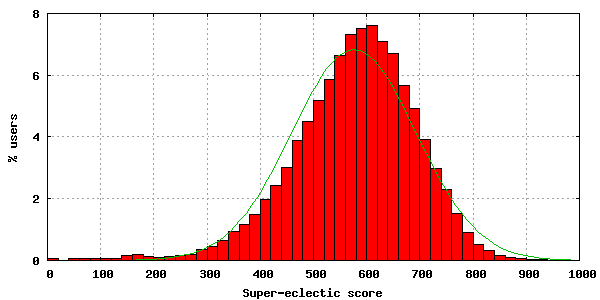
AEP (Anti-Exponential Points):
This metric essentially looks at the number of plays your most favored artist gets vs. the number of plays of your 50th most favored artist. The underlying math looks a little stupid to me, but it does look at something that the previous metric avoids, namely the degree of concentration in the top tier. Anyway, I submitted myself to the test and got a 3.69/5, which again means I'm not super diverse, but I don't suck either. Unfortunately, these guys didn't put together a neat little histogram of their distributions.
There is, however, a group of high-scoring and low-scoring people. Both of them (and particularly the high-scoring set) seem to do nothing but listen to Radiohead all the time.

I stopped using last.fm for a while, because the service was still pretty clunky and the Scrobbler (where do they get these words?) would crash my computer pretty routinely. Besides, last.fm couldn't keep track of anything that I listened to off of the computer, which at that point was about 60% of my musical consumption. So, I let iTunes keep track of all my musical doings.
Today, I imported all of my iTunes history back into last.fm and am now using it to manage everything. I had to ditch my old last.fm profile, but in return, I get to see about 25x more data. Looking at the evidence, I'm struck by a few things about myself.
1. My listening habits are highly concentrated in a core set of artists. I wish I could pop the data into Excel so I could draw up the concentration chart.
2. I'm a lot less musically adventurous than I thought I was. Back in the day, I would have said that I'm pretty balanced across genres. The data doesn't lie - I'm a dyed-in-the-wool mainstream rock fan with indie leanings. Hip hop and electro are just blips on the radar of my listening habits.
3. I'm a lot less passionate about the music that I'm listening to today. My profile is almost entirely based on what I listened to about a year ago. Since then, I've barely listened to anything in my Top 20 artists/albums. Of the albums that I'm listening to now, they barely register in my overall charts.
If I ever have a kid, I'm going to have him scrobble pretty much everything he/she listens to. I think it would be so cool to have the entire history of your musical consumption ready for review. In case anyone's interested in seeing my tastes, ranging from roughly January 2006 to the present, take a look here.
Robert Shiller in the NYTimes on information cascades:
ONE great puzzle about the recent housing bubble is why even most experts didn’t recognize the bubble as it was forming.First, this article reminds me of all those guys that tried to prove that there wasn't a housing crisis in '07 by pointing at market reactions. At least Ben Stein used external data points to hypothesize that nothing was happening.
...
Three economists, Sushil Bikhchandani, David Hirshleifer and Ivo Welch, in a classic 1992 article, defined what they call “information cascades” that can lead people into serious error. They found that these cascades can affect even perfectly rational people and cause bubblelike phenomena. Why? Ultimately, people sometimes need to rely on the judgment of others, and therein lies the problem. The theory provides a framework for understanding the real estate turbulence we are now observing.
...
The fundamental problem is that the information obtained by any individual — even one as well-placed as the chairman of the Federal Reserve — is bound to be incomplete. If people could somehow hold a national town meeting and share their independent information, they would have the opportunity to see the full weight of the evidence. Any individual errors would be averaged out, and the participants would collectively reach the correct decision.
Of course, such a national town meeting is impossible. Each person makes decisions individually, sequentially, and reveals his decisions through actions — in this case, by entering the housing market and bidding up home prices.
Suppose houses are really of low investment value, but the first person to make a decision reaches the wrong conclusion (which happens, as we have assumed, 40 percent of the time). The first person, A, pays a high price for a home, thus signaling to others that houses are a good investment.
The second person, B, has no problem if his own data seem to confirm the information provided by A’s willingness to pay a high price. But B faces a quandary if his own information seems to contradict A’s judgment. In that case, B would conclude that he has no worthwhile information, and so he must make an arbitrary decision — say, by flipping a coin to decide whether to buy a house.
The result is that even if houses are of low investment value, we may now have two people who make purchasing decisions that reveal their conclusion that houses are a good investment.
As others make purchases at rising prices, more and more people will conclude that these buyers’ information about the market outweighs their own.
Less snidely, I think this crystallizes/explains an argument that I've had against the efficiency of markets for a long time. Think about markets as a Wikipedia for pricing information. Looking past a lot of the obvious parallels (e.g. crowd sourcing, larger players having a marked impact on the outcome, etc.), there is one key difference. In writing a Wikipedia article, you could never cite Wikipedia as the source. As hypothesized above, this doesn't seem to be the case with the market.
The media in the living room
0 comments Published by Panda on Thursday, February 28, 2008 at 9:25 AMMicrosoft and Sony have been trying for years to bring the experience of the PC to the living room, spending millions of dollars in state of the art consoles that were supposed to merge all of your media into a single station. To this day, that hasn't happened. Stubbornly, the Internet has stayed glued to the desktop.
Except in one spot - the mobile phone. Why is it that the phone, which at first seemed somewhat ill-suited to Internet browsing, has managed to become the next hub of development? It's because the phone changed its form to accommodate some of the new demands that were being placed on it. They made their screens bigger, added full-fledged keyboards and data connections. Hell, the iPhone even introduced a touch screen to simulate the mouse-click.
What have Microsoft and Sony done? They added Internet connections to their video game consoles and then developed proprietary systems that allow people to connect to each other solely in the context of the universe that they've tried to create. At least the Wii has an Opera browser. If any of these guys really want to harness the power of the Internet in the living room, here's what I would suggest:
1. Allow the millions of portable keyboards (i.e. Blackberries, iPhones, etc.) in the world to be used in conjunction with the system. If you don't have a keyboard, it's pretty darn hard to get around the web.
2. Open up the platform and let other developers create an ecosystem that takes advantage of the technology.
Until this happens, those consoles are just consoles. Not Trojan horses that can be used to take over the rest of the Internet. Because at this point, that seriously isn't going to happen.
I got bored last night and set up a new tumblelog, iamverytall.tumblr.com. For those of you that don't know what a tumblog is, the line that they give is:
"If blogs are journals, tumblelogs are scrapbooks."After actually looking at how tumblelogs (that's a really long name, now that I have to keep typing it) work, I have to admit that I don't really get it. The chief differentiator between a tlog (ah, much shorter) and a blog is that it's a lot easier to add media posts to tlogs than it is to blogs, e.g. you don't have to find an alternate site to host that mp3 that you want to put up, you can e-mail photos from your phone, etc. But that's additional functionality, and it doesn't preclude me from using tumblr in the exact same way that I use Blogger. Maybe I'm missing something, but it's hard to see why a blog is any more text-friendly than the tlog, save for the most superficial of reasons. Bottom line, there's no obvious reason that the tblog can't be both a journal and a scrapbook, and if I'm going to manage an online presence, I'd rather do it where I have more options, not less.
Of course, I could be missing something. So I'll play along with it for now, and will probably use it to post music, pictures, etc.

I would be really surprised if facebook's growth was over, but I think it's only to be expected that the rate of growth is starting to slow. Part of it has got to be that long-time users are coming in less frequently. Most of my friends that have been on since '04 barely log in anymore - the fascination with endlessly surfing through your friends' photos eventually loses its hold. Wall posting is great, but it can eventually lose its luster.
Pudge still checks up on facebook with great frequency. When one of her coworkers broke up a gaggle of facebook talk by saying, "Facebook is lame," Pudge responded by saying, "Andrew is old."
My guess is that facebook will have to macro-drivers that will push it forward for years to come. The first is international expansion. While I was in Istanbul, I was amazed to find that the majority of people at the client site were totally engrossed by facebook (one of them friended me within 30 minutes of our first meeting). They'd all heard about it before and were extraordinarily anxious to use it. I'm guessing that this will be largely the case in numerous countries, save for a couple with already well-entrenched players. This seems to be borne out by facebook's global numbers:
Link.

That’s according to researchers at the University of Wisconsin who are studying people’s attitudes towards nanotechnology, an emerging scientific field that involves manipulating molecules and atoms. They found that just 29.5% of the 1,000-plus Americans surveyed said they thought nanotechnology research was morally acceptable.Do these people even know what they're condemning?
Hopefully, the US will loosen up its H1-B policies so we can actually get a couple people with real educations into the country.

Perhaps in response to criticisms that have been building in recent days, Mr. Obama pivoted Tuesday from his usual incantations. He dropped the pretense of being a candidate of inspiring but undescribed "post-partisan" change. Until now, Mr. Obama has been making appeals to the center, saying, for example, that we are not red or blue states, but the United States. But in his Houston speech, he used the opportunity of 45 (long) minutes on national TV to advocate a distinctly non-centrist, even proudly left-wing, agenda. By doing so, he opened himself to new and damaging contrasts and lines of criticism.Is this what's coming down the pike?
Mr. McCain can now question Mr. Obama's promise to change Washington by working across party lines. Mr. Obama hasn't worked across party lines since coming to town. Was he a member of the "Gang of 14" that tried to find common ground between the parties on judicial nominations? Was Mr. Obama part of the bipartisan leadership that tackled other thorny issues like energy, immigration or terrorist surveillance legislation? No. Mr. Obama has been one of the most dependably partisan votes in the Senate.
...Unlike Bill Clinton in 1992, Mr. Obama is completely unwilling to confront the left wing of the Democratic Party, no matter how outrageous its demands, no matter how out of touch it might be with the American people. And Tuesday night, in a key moment in this race, he dropped the pretense that his was a centrist agenda. His agenda is the agenda of the Democratic left.
In recent days, courtesy of Massachusetts Gov. Deval Patrick, Mr. Obama has invoked the Declaration of Independence, Martin Luther King, Jr., and Franklin Roosevelt to show the power of words. But there is a critical difference between Mr. Obama's rhetoric and that of Jefferson, King and FDR. In each instance, their words were used to advance large, specific purposes -- establishing a new nation based on inalienable rights; achieving equal rights and a color-blind society; giving people confidence to endure a Great Depression. For Mr. Obama, words are merely a means to hide a left-leaning agenda behind the cloak of centrist rhetoric. That garment has now been torn. As voters see what his agenda is, his opponents can now far more effectively question his authenticity, credibility, record and fitness to be leader of the free world.
Iron Chef America - Exposed?
0 comments Published by Panda on Thursday, February 21, 2008 at 12:27 PM
Several things slowly dawned on us as we watched the taping. The participants went about their tasks methodically but unhurriedly, as if they had all the time in the world. There was none of the huddling and dialogue among team members that we expected, even though they had to develop a menu from scratch using an unknown ingredient. Like a lightbulb coming on over our heads, we realized that the chefs had known the identity of the main ingredient all along, just as they had known ahead of time which Iron Chef would be paired with the challenger. How else to explain the utter nonchalance displayed by the sous chefs, who fetched ingredients and blended them; toasted, fried, and roasted them; then plated them like they were enjoying a relaxing holiday in the country.Seriously, did anyone actually think that they were all just whipping out four-five courses without knowing anything before taping? For the most part, Sietsama seems to get really upset that a lot of stuff in the Iron Chef TV show aren't actually true in real life. I'm pretty surprised that anyone thought that they would be. That being said, he does mention a couple of things that are kind of interesting. They are:
* The competing Iron Chef is chosen before the show is taped - the other chefs are actually just look-alike stand-ins
* The chefs actually aren't all that rushed while they're making their dishes
* The judging section of the show takes 3 hours to tape
Link originally via Eater
Ok, this should be my last post for today, promise. I've been talking to Pudge about whether or not we think a recession is here/on the horizon. From what I've read, it's here and it's going to be long, big and nasty. Read that as: If you've got a job, try your best not to get fired.
From what she's read, it might be here, but even if it is, it probably won't last that long. Her view is that while the American consumer will probably be hard hit, a significant portion of the American economy has achieved enough global exposure to absorb the adverse effects. At least, I think that's what she said; if I'm wrong, she can always add a comment and correct me.
Anyway, just to add some fuel to the fire, here are a few select comments from the esteemed Marty Feldstein, whom some of you Harvard types might remember as being one of the inspirations for Mr. Burns (italics are mine):
Here's a quick bullet point summary of the rest of the article:Although it is too soon to tell whether the United States has entered a recession, there is mounting evidence that a recession has in fact begun. Key measures of economic activity stopped growing in December and January or actually began to decline. The collapse of house prices and the crisis in the credit markets continue to depress the real economy...
If a recession does occur, it could last longer and be more painful than the past several downturns because of differences in its origin and character. The recessions that began in 1991 and 2001 lasted only eight months from the start of the downturn until the beginning of the recovery. Even the deeper recession of 1981 lasted only 16 months.But these past recessions were caused by deliberate Federal Reserve policy aimed at reversing a rise in inflation. In those cases, the Fed increased real interest rates until it saw the economic slowdown that it thought would move us back toward price stability. It then reversed course, reducing interest rates and bringing the recession to an end.
In contrast, the real interest rate in 2006 and 2007 stayed at a relatively low level of less than 3%. A key cause of the present slowdown and potential recession was not a tightening of monetary policy but the bursting of the house-price bubble after six years of exceptionally rapid house-price increases. The Fed therefore will not be able to end the recession as it did previous ones by turning off a tight monetary policy.

* Fall in national housing prices is unprecedented, depressing wealth and consumer spending
* Biggest problem is the paralysis of/lack of confidence in the credit markets
* No one has any idea how much their credit instruments are now worth, which is preventing anyone from buying anything
* Unfortunately, the only way we know how to establish market value for these instruments is by seeing how much other participants are paying for them
* No one has any idea how to fix any of this
For those of you that have any interest in this kind of thing, I'd recommend reading Feldstein's article. Similar to the subprime primer that I linked to the other day, it also provides a crystal clear view of the situation at hand, albeit with fewer stick figures.
Link via the Big Picture

If you're willing to look, there's a substantial amount of substance behind that Obama style. For starters, explore the Obama campaign Web site, and you'll find the standard array of campaign-issue papers on the economy, health care, Iraq and foreign policy. And now, the Obama campaign managers are responding to Sen. Clinton's criticism by highlighting and, well, beefing up those position papers.Now, the interesting point:
Here's the rub: As anyone who has listened to Sen. Obama knows, the substance of policy positions takes a decided back seat to the more ephemeral ideas of hope and inspiration when he addresses voters. The basic Obama argument is that America can solve its problems, that the country can transcend partisan divides, that Washington can overcome gridlock and that he, as a new leader unbound by the debates of the past 20 years, is the one who can make all those things happen.I've tended to ignore most people's arguments that Obama is light on substance, given the complementary set-up and the "Obama is pretty much the same as Hillary on the positions" argument. But I do think the commentator is right - people are not necessarily voting for Obama's positions as much as they're voting for his brand of politics. If that's the case, I'd be curious to see what will happen once he gets into office and what will come of his efforts to actually get people behind his ideas.
The beauty of this Obama approach, aside from its presenter's impressive oratorical skills, is that it is so in tune with the mood of many Americans, who seem to want both to be inspired and to leap beyond partisanship.
The risk, though, is that rhetoric that is light on substance might fail to unite voters in either party or the country behind specific, often difficult, steps a new president would have to take. Campaigns are for winning -- and for building a consensus on what is to be done after the victory.
In this case, is Sen. Obama building a case for renegotiating the North American Free Trade Agreement, or for ending it? Is withdrawing troops from Iraq within 16 months a goal or a deadline? They are significant questions, and Sen. Obama's task is to be sure his campaign is shedding light on the answers.