The media in the living room
0 comments Published by Panda on Thursday, February 28, 2008 at 9:25 AMMicrosoft and Sony have been trying for years to bring the experience of the PC to the living room, spending millions of dollars in state of the art consoles that were supposed to merge all of your media into a single station. To this day, that hasn't happened. Stubbornly, the Internet has stayed glued to the desktop.
Except in one spot - the mobile phone. Why is it that the phone, which at first seemed somewhat ill-suited to Internet browsing, has managed to become the next hub of development? It's because the phone changed its form to accommodate some of the new demands that were being placed on it. They made their screens bigger, added full-fledged keyboards and data connections. Hell, the iPhone even introduced a touch screen to simulate the mouse-click.
What have Microsoft and Sony done? They added Internet connections to their video game consoles and then developed proprietary systems that allow people to connect to each other solely in the context of the universe that they've tried to create. At least the Wii has an Opera browser. If any of these guys really want to harness the power of the Internet in the living room, here's what I would suggest:
1. Allow the millions of portable keyboards (i.e. Blackberries, iPhones, etc.) in the world to be used in conjunction with the system. If you don't have a keyboard, it's pretty darn hard to get around the web.
2. Open up the platform and let other developers create an ecosystem that takes advantage of the technology.
Until this happens, those consoles are just consoles. Not Trojan horses that can be used to take over the rest of the Internet. Because at this point, that seriously isn't going to happen.
I got bored last night and set up a new tumblelog, iamverytall.tumblr.com. For those of you that don't know what a tumblog is, the line that they give is:
"If blogs are journals, tumblelogs are scrapbooks."After actually looking at how tumblelogs (that's a really long name, now that I have to keep typing it) work, I have to admit that I don't really get it. The chief differentiator between a tlog (ah, much shorter) and a blog is that it's a lot easier to add media posts to tlogs than it is to blogs, e.g. you don't have to find an alternate site to host that mp3 that you want to put up, you can e-mail photos from your phone, etc. But that's additional functionality, and it doesn't preclude me from using tumblr in the exact same way that I use Blogger. Maybe I'm missing something, but it's hard to see why a blog is any more text-friendly than the tlog, save for the most superficial of reasons. Bottom line, there's no obvious reason that the tblog can't be both a journal and a scrapbook, and if I'm going to manage an online presence, I'd rather do it where I have more options, not less.
Of course, I could be missing something. So I'll play along with it for now, and will probably use it to post music, pictures, etc.

I would be really surprised if facebook's growth was over, but I think it's only to be expected that the rate of growth is starting to slow. Part of it has got to be that long-time users are coming in less frequently. Most of my friends that have been on since '04 barely log in anymore - the fascination with endlessly surfing through your friends' photos eventually loses its hold. Wall posting is great, but it can eventually lose its luster.
Pudge still checks up on facebook with great frequency. When one of her coworkers broke up a gaggle of facebook talk by saying, "Facebook is lame," Pudge responded by saying, "Andrew is old."
My guess is that facebook will have to macro-drivers that will push it forward for years to come. The first is international expansion. While I was in Istanbul, I was amazed to find that the majority of people at the client site were totally engrossed by facebook (one of them friended me within 30 minutes of our first meeting). They'd all heard about it before and were extraordinarily anxious to use it. I'm guessing that this will be largely the case in numerous countries, save for a couple with already well-entrenched players. This seems to be borne out by facebook's global numbers:
Link.

That’s according to researchers at the University of Wisconsin who are studying people’s attitudes towards nanotechnology, an emerging scientific field that involves manipulating molecules and atoms. They found that just 29.5% of the 1,000-plus Americans surveyed said they thought nanotechnology research was morally acceptable.Do these people even know what they're condemning?
Hopefully, the US will loosen up its H1-B policies so we can actually get a couple people with real educations into the country.

Perhaps in response to criticisms that have been building in recent days, Mr. Obama pivoted Tuesday from his usual incantations. He dropped the pretense of being a candidate of inspiring but undescribed "post-partisan" change. Until now, Mr. Obama has been making appeals to the center, saying, for example, that we are not red or blue states, but the United States. But in his Houston speech, he used the opportunity of 45 (long) minutes on national TV to advocate a distinctly non-centrist, even proudly left-wing, agenda. By doing so, he opened himself to new and damaging contrasts and lines of criticism.Is this what's coming down the pike?
Mr. McCain can now question Mr. Obama's promise to change Washington by working across party lines. Mr. Obama hasn't worked across party lines since coming to town. Was he a member of the "Gang of 14" that tried to find common ground between the parties on judicial nominations? Was Mr. Obama part of the bipartisan leadership that tackled other thorny issues like energy, immigration or terrorist surveillance legislation? No. Mr. Obama has been one of the most dependably partisan votes in the Senate.
...Unlike Bill Clinton in 1992, Mr. Obama is completely unwilling to confront the left wing of the Democratic Party, no matter how outrageous its demands, no matter how out of touch it might be with the American people. And Tuesday night, in a key moment in this race, he dropped the pretense that his was a centrist agenda. His agenda is the agenda of the Democratic left.
In recent days, courtesy of Massachusetts Gov. Deval Patrick, Mr. Obama has invoked the Declaration of Independence, Martin Luther King, Jr., and Franklin Roosevelt to show the power of words. But there is a critical difference between Mr. Obama's rhetoric and that of Jefferson, King and FDR. In each instance, their words were used to advance large, specific purposes -- establishing a new nation based on inalienable rights; achieving equal rights and a color-blind society; giving people confidence to endure a Great Depression. For Mr. Obama, words are merely a means to hide a left-leaning agenda behind the cloak of centrist rhetoric. That garment has now been torn. As voters see what his agenda is, his opponents can now far more effectively question his authenticity, credibility, record and fitness to be leader of the free world.
Iron Chef America - Exposed?
0 comments Published by Panda on Thursday, February 21, 2008 at 12:27 PM
Several things slowly dawned on us as we watched the taping. The participants went about their tasks methodically but unhurriedly, as if they had all the time in the world. There was none of the huddling and dialogue among team members that we expected, even though they had to develop a menu from scratch using an unknown ingredient. Like a lightbulb coming on over our heads, we realized that the chefs had known the identity of the main ingredient all along, just as they had known ahead of time which Iron Chef would be paired with the challenger. How else to explain the utter nonchalance displayed by the sous chefs, who fetched ingredients and blended them; toasted, fried, and roasted them; then plated them like they were enjoying a relaxing holiday in the country.Seriously, did anyone actually think that they were all just whipping out four-five courses without knowing anything before taping? For the most part, Sietsama seems to get really upset that a lot of stuff in the Iron Chef TV show aren't actually true in real life. I'm pretty surprised that anyone thought that they would be. That being said, he does mention a couple of things that are kind of interesting. They are:
* The competing Iron Chef is chosen before the show is taped - the other chefs are actually just look-alike stand-ins
* The chefs actually aren't all that rushed while they're making their dishes
* The judging section of the show takes 3 hours to tape
Link originally via Eater
Ok, this should be my last post for today, promise. I've been talking to Pudge about whether or not we think a recession is here/on the horizon. From what I've read, it's here and it's going to be long, big and nasty. Read that as: If you've got a job, try your best not to get fired.
From what she's read, it might be here, but even if it is, it probably won't last that long. Her view is that while the American consumer will probably be hard hit, a significant portion of the American economy has achieved enough global exposure to absorb the adverse effects. At least, I think that's what she said; if I'm wrong, she can always add a comment and correct me.
Anyway, just to add some fuel to the fire, here are a few select comments from the esteemed Marty Feldstein, whom some of you Harvard types might remember as being one of the inspirations for Mr. Burns (italics are mine):
Here's a quick bullet point summary of the rest of the article:Although it is too soon to tell whether the United States has entered a recession, there is mounting evidence that a recession has in fact begun. Key measures of economic activity stopped growing in December and January or actually began to decline. The collapse of house prices and the crisis in the credit markets continue to depress the real economy...
If a recession does occur, it could last longer and be more painful than the past several downturns because of differences in its origin and character. The recessions that began in 1991 and 2001 lasted only eight months from the start of the downturn until the beginning of the recovery. Even the deeper recession of 1981 lasted only 16 months.But these past recessions were caused by deliberate Federal Reserve policy aimed at reversing a rise in inflation. In those cases, the Fed increased real interest rates until it saw the economic slowdown that it thought would move us back toward price stability. It then reversed course, reducing interest rates and bringing the recession to an end.
In contrast, the real interest rate in 2006 and 2007 stayed at a relatively low level of less than 3%. A key cause of the present slowdown and potential recession was not a tightening of monetary policy but the bursting of the house-price bubble after six years of exceptionally rapid house-price increases. The Fed therefore will not be able to end the recession as it did previous ones by turning off a tight monetary policy.

* Fall in national housing prices is unprecedented, depressing wealth and consumer spending
* Biggest problem is the paralysis of/lack of confidence in the credit markets
* No one has any idea how much their credit instruments are now worth, which is preventing anyone from buying anything
* Unfortunately, the only way we know how to establish market value for these instruments is by seeing how much other participants are paying for them
* No one has any idea how to fix any of this
For those of you that have any interest in this kind of thing, I'd recommend reading Feldstein's article. Similar to the subprime primer that I linked to the other day, it also provides a crystal clear view of the situation at hand, albeit with fewer stick figures.
Link via the Big Picture

If you're willing to look, there's a substantial amount of substance behind that Obama style. For starters, explore the Obama campaign Web site, and you'll find the standard array of campaign-issue papers on the economy, health care, Iraq and foreign policy. And now, the Obama campaign managers are responding to Sen. Clinton's criticism by highlighting and, well, beefing up those position papers.Now, the interesting point:
Here's the rub: As anyone who has listened to Sen. Obama knows, the substance of policy positions takes a decided back seat to the more ephemeral ideas of hope and inspiration when he addresses voters. The basic Obama argument is that America can solve its problems, that the country can transcend partisan divides, that Washington can overcome gridlock and that he, as a new leader unbound by the debates of the past 20 years, is the one who can make all those things happen.I've tended to ignore most people's arguments that Obama is light on substance, given the complementary set-up and the "Obama is pretty much the same as Hillary on the positions" argument. But I do think the commentator is right - people are not necessarily voting for Obama's positions as much as they're voting for his brand of politics. If that's the case, I'd be curious to see what will happen once he gets into office and what will come of his efforts to actually get people behind his ideas.
The beauty of this Obama approach, aside from its presenter's impressive oratorical skills, is that it is so in tune with the mood of many Americans, who seem to want both to be inspired and to leap beyond partisanship.
The risk, though, is that rhetoric that is light on substance might fail to unite voters in either party or the country behind specific, often difficult, steps a new president would have to take. Campaigns are for winning -- and for building a consensus on what is to be done after the victory.
In this case, is Sen. Obama building a case for renegotiating the North American Free Trade Agreement, or for ending it? Is withdrawing troops from Iraq within 16 months a goal or a deadline? They are significant questions, and Sen. Obama's task is to be sure his campaign is shedding light on the answers.
I'm not an economist, but I do like reading blogs from economists. One of the things that I've picked up on from some posts has been the idea that China is not a source of inflation, when you look at the data. Here's a clip from the WSJ:
“Imports constitute around 15% of U.S. GDP and around 13% of that comes from China,” the authors write in an article in the latest issue of China & World Economy, an English-language journal published by the Chinese Academy for Social Sciences. On their back-of-the-envelope calculation, that means a 1 percentage point increase in China’s inflation rate should lead to an increase in U.S. inflation of 0.02 to 0.03 percentage points. Yet their comparison of historical price trends in China with those in both the U.S. and Japan found the actual effect was even smaller.And here's one from Paul Krugman:
In fact, overall, the US spends a little more than 2 percent of GDP on Chinese goods. That’s dramatically more than in the past. But it suggests that if Chinese prices rise 10%, the overall cost of living here would rise by less than a quarter of a percent. Every little bit hurts, but this isn’t as big a deal as a casual reading of this article might lead you to think.Fine, so if the prices of Chinese imports go up, the total effect in the US won't be that big. But, what about the effect of China on the price of commodity inputs? Here's a graph of real oil prices in Feb. 2008 dollars.
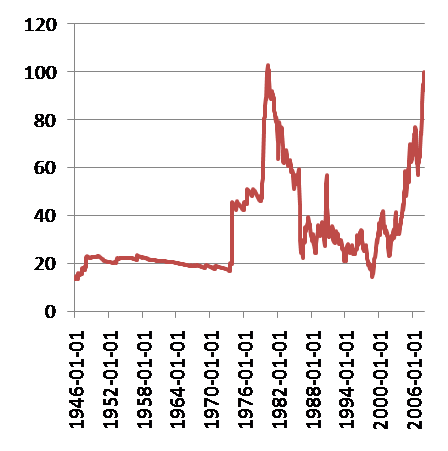 Now, what I've been reading is that the run-up in oil prices can be partially attributed to Fed Monetary policy. But the other thing that could be driving it is huge demand growth coming from China, and to a lesser extent India. I have no way of telling which of these two factors is playing a larger role. However, let's say that factor #2 is in fact big. Wouldn't that subsequently mean that China is playing a significant role in global inflation? Someone enlighten me.
A couple days ago, I had a thought about food trends. The thought was that food staples have essentially been commoditized, due to the manufacturing processes used to achieve scale. This has opened the door for higher end, branded food products that trump up their home-grown processes. Hence Berkshire pork, slow-churn ice cream, Niman Ranch bacon, artisanal cheeses, fresh hand-made pasta made from durum, and all that jazz. My thought was that something like that would soon happen to butter, as there is clearly room for differentiation in both the process (e.g. freshness of the ingredients, churning style) and the perceived quality of the output.
Lo and behold:
ANNE SAXELBY had what she calls an “aha moment” a couple of years ago when she drove upstate to try the cultured butter made by Evans Farmhouse Creamery in Chenango County. Ms. Saxelby, who owns Saxelby Cheesemongers in Manhattan, said that for all the butter she had eaten in her life, “I had really never had butter before — this is butter.”
More and more people across the country are being treated to the same aha experience as they find a burgeoning variety of fresh dairy products made in small batches on little farms and in small creameries. And it’s worth the extra money.
Of course, anecdotes in the Times do not a trend make. But still, it's always fun when something that you were thinking about shows up in print within a couple of days.
Speaking of anecdotes, from the same article:
Nancy Nipples started the Pike Place Market Creamery in Seattle 30 years ago, selling milk, butter, cream and the like to help local independent dairies... (Nancy Nipples is the name she uses to sign checks; her full name, taken after a divorce, is Nancy Nipples the Milkmaid.)Her name is what?!
Link courtesy of Pudge
From Ars Technica:
Effective immediately, Toshiba will ramp down shipments of HD DVD players with an eye towards stopping them altogether by the end of March. The company left open the possibility of continuing to ship laptops with HD DVD drives installed, but it's difficult to believe that there would be any demand for them
Glad I'm no longer one of those early adopter types.
As many of you might have guessed from the recent flurry, I'm a touch bored these days. There hasn't been a lot of project flow and I'm still waiting to hear back from some people on things that I've sent out. In any case, here's an interesting factoid that I just found.
I've been going through consumer bankruptcy filings recently and have been astounded by the levels of credit card debt that show up on some (but certainly not most) debtor's schedules of assets and liabilities. I've seen a bunch of cases with upwards of $60,000 of debt for a single debtor, a few with over $100,000, and the current record holder is $175,862.27. Yes, that's right, $175,862.27. That's larger than a lot of mortgages.Yowch.
This debt was incurred on 25 cards from 12 different lenders, all major national financial institutions. No less than 9 of the cards and $80744.16 of the debt were for one lender, Bank of America. The debtor's annual post-tax income is listed at around $85,000, and the debtor has been in her current job and industry for a while.
Link.
This is about as clear of a picture of the subprime mortgage mess that you'll ever get. Stick figures included:
[Link via The Big Picture]

This post was inspired by a recent post at RW/W about Moody, a 3rd-party app for iTunes that allows you to do "mood-tagging." Basically, it just organizes your songs into playlists for you, which I think is pretty useless. But I think the problem it's trying to solve is one that would make my life a lot easier. Over the years, I've amassed a pretty sizable collection of music. Organizing it in a clean, understandable fashion has definitely been one of my biggest frustrations.
There may be some of you out there that don't bother to organize your music and wonder why I would even care to do so. The primary answer is for browsability. I have so much music that I frequently forget what I do/don't have, and find myself often rediscovering albums. The holy grail of organization would make this process a lot easier.
I use iTunes as my primary music player. The search function is great. I like that it keeps track of what I've listened to both on the computer and on my iPod/iPhone. I've rated a ton of songs and I think that makes it a lot easier for me to refind songs that I like. And I think that the browser is a lot easier to manage then a bunch of folders on a hard disk, as it simultaneously cuts across the three axes of music-browsing - artist, album, and genre. You could toss year released in there, but I think that's a bit tougher to use.
For browsing purposes though, genre really seems to be the only way to go, for a couple reasons. First and foremost, given a sufficiently large selection, there will be too many artists and albums. Secondly, except for a few rare outliers, there won't be enough musical variety within one artist/album, meaning that you have to keep switching around if you want to put together a playlist of any variety. Thirdly, artists/albums are pretty concretely defined categories, meaning that the contents of these categories aren't really that subject to change.
The problem with using genres for browsing is that it's a huge pain to label things. You can only apply one genre to each song! That's pretty useless in my book. A lot of good music cuts across genres. Even bad music cuts across genres, to be honest (e.g. Diddy-influenced fusion of R&B and hip hop).
Solution: Apple, allow people to tag songs in iTunes.
Before anyone goes rushing off to tell me about awesome online apps that do this, let me answer by saying that I'm really not interested in using web interfaces for this kind of thing. When you're managing this much volume, the extra portion of a second per operation will translatesinto a cumulatively huge difference.

From the NYTimes:
Reaction #1.Mr. Obama’s campaign said that he had a lead of 1,139 to 1,003; by the count of the Clinton campaign organization, Mr. Obama was doing even better: 1,141 to 1,004 for Mrs. Clinton.
There are 1,082 delegates left to be selected.
With every delegate precious, Mrs. Clinton’s advisers also made it clear that they were prepared to take a number of potentially incendiary steps to build up Mrs. Clinton’s count. Top among these, her aides said, is pressing for Democrats to seat the disputed delegations from Florida and Michigan, who held their primaries in January in defiance of Democratic Party rules.Reaction #2.
The delegate math set up a new front in the battle for the party’s presidential nomination, one based on competing views of how the party leaders and elected officials whose vote will determine the outcome should make their decisions.
Mrs. Clinton’s aides said the delegates should make their decision based on who they thought would be the stronger candidate and president. Mr. Obama argues that they should follow the will of the Democratic Party as expressed in the primary and caucuses — meaning the candidate with the most delegates from the voting.
Branding is one area of business that remains a mystery to me. All the things that you do with your brand, that makes sense to me. But the initial design, particularly of the logo, is something I've always found to be outside of my core competencies. Some people have that kind of creativity, others (me) don't.
The following are snippets from an article from Google Operating System, originally from Wired, about how Google designed their now world-famous logo. "In the process, Ruth used a lot of symbols: from a pattern that suggests the infinite to interlocking rings that symbolize the power of search to transgress cultures, from a happy magnifying glass to sheer playfulness. "By taking out the magnifying glass, Kedar opens up the logo to signify that Google can become much more than just a search engine. By playing with the angles and colors of the letters, she tries to make clear that Google isn't a square corporation."
Ruth Kedar explains that she chose the Catull typeface because "Catull borrows elements from traditional writing instruments such as the quill and the chisel with a modern twist. Search, by nature, is an activity that requires we look into the past. Therefore Catull's historical ties seemed appropriate, as did the bridging between the old analog world and the new emerging digital era."
As a follow-up to the Wikinvest post, I grabbed the following adoption curve from Barry Ritholtz at the big picture. It's an illustrative curve depicting technological adoption. I'm assuming that the x-axis is time and the y-axis is the rate of adoption, although Ritholtz never made that comment explicitly.
Here is a grossly over-simplified discussion of how this works: When the innovators buy a product, they essentially are paying for all of the R&D costs, and other development expenses. You paid 365 labor units for a VCR in 1972 because they were a limited production, custom product that was practically hand made. When a PC cost 465 labor units, chip fabs were nowhere near as plentiful as today -- and the biggest cost in early PCs were the exorbitant chipsets contained in them.One thing that Ritholtz doesn't mention is the chain of causality linking the pricing effects he's describing and the actual rate of adoption. My guess is that there's a feedback effect between the two, with higher adoption rates spurring incremental upgrades to manufacturing capacity and the resulting reduction in prices drives further adoption by those that might have previously been priced out of the market.
The early adopters pay less than the innovators, as factories get built to mass produce chips or tape transport mechanisms or cell phone keypads. What was a nearly custom made product becomes a merely limited-production, high-end one. Where the innovators paid for the R&D, the early adopters paid for the fabs and factories to be built.
The early majority doesn't get the use of the product for the first few years, but they get a big price benefit of manufacturing economies of scale. Mass production of components bring prices down; successful products attract competition to the space, and soon more manufacturers are cranking out more units. Through competition, prices begin dropping faster and faster. The late majority gets even cheaper prices. Consider the laggards and the VCR today -- they cost about $29 each.
Of course, this is a highly simplified view of how the market works. Adding one layer of complexity, what happens if price isn't an issue, as it is in most internet properties? I'm thinking the curve would look largely the same, but with much sharper swings, as adoption would largely be driven by network effects, rather than any dependency on manufacturing capability. That is, without the iterative feedback loop smoothing adoption rates, you'd see much more sensitivity to single events, e.g. a bump on TechCrunch.
There's a possibility that there could be an adoption curve based on the site's evolution. Essentially, rather than pegging adoption rates to the product's monetary cost, you could peg it to the frictional cost of using the site. For instance, I stopped using Wesabe mainly because it wouldn't actually pick up some of my account information, making it much more of a hassle to use their site. Assuming that over time, they identify and fix these issues, it's possible that I'll come back. Again, just idle speculation. Anyways, back to work.
Every so often, I add widgets to the side of the page. It's very easy now that Blogger's been revamped. However, every time I add a new widget, the widget will default to include the following html snippet.
In theory, I think that snippet should allow me to make "quick edits" to the blog, as long as I'm logged in. In practice, that snippet just adds a load of white space to the widget and forces everything that follows it to the bottom of the page. This means I have to cut that snippet out every time I add a new widget, which can be a pain in the butt. If anyone's got an idea of how to fix this, let me know.

Just some quick commentary on the site, from my perspective.
Things they're getting right:
I think they're doing a pretty good job along a couple of fronts. First, I think the reputation system is pretty good (i.e. better than I've seen at other Wiki's), and could function as a modest incentive to get people to add what they know. Will it stop people from trying to game the system? I'm less confident about that. But still, given that the name of the game is to build critical mass, providing some incentives is far better than providing none.
Second, I think their seed content is a good step in the right direction. To be honest, if the content wasn't as good as it is, I think the site would be DOA. Again, it's a good step, but it still feels incomplete. I think they need to keep building on the seed until they have enough of an audience that it will start building itself.
Third, I haven't seen it yet, but the data tables that they're going to roll out sound like they'll be good. It's an open question as to whether they'll actually work, but if they do, that would be a strong development.
Things to work on:
The chief aim, for now and forever, is to build an audience. Moreover, that needs to be a recurring audience, as opposed to a spiky, one-time audience (e.g. the kind of audience Elfyourself had). Ideally, that audience should be engaged enough that they'll start contributing and take the content-development burden off of the site's editors.
I think the last point should be the key focus. Right now, I think there's enough reasonable content that they might be able to attract users for a bit. But without a focal point of engagement, they won't come back, nor will they contribute. Their current initiative - adding data tables - will make the site more useful to casual visitors, but it strikes me as being yet another piece that they'll have to seed and update until they build critical mass.
Here are some thoughts:
* They should do everything they can to turn their list of contributors into a community. I'd imagine that they should at least have a news feed and forums/discussion boards, rather than their current freeform discussion pages
* They should emulate Wikipedia and funnel visitor contributions towards certain key pages, so as to facilitate more visible development
* They should build on their current reputation system and begin rewarding high-performing contributors in some way
* Structuring an entire post is likely to be too big for a casual visitor. Somehow streamlining this process, or maybe creating a standard template, would make this process go a lot more smoothly